
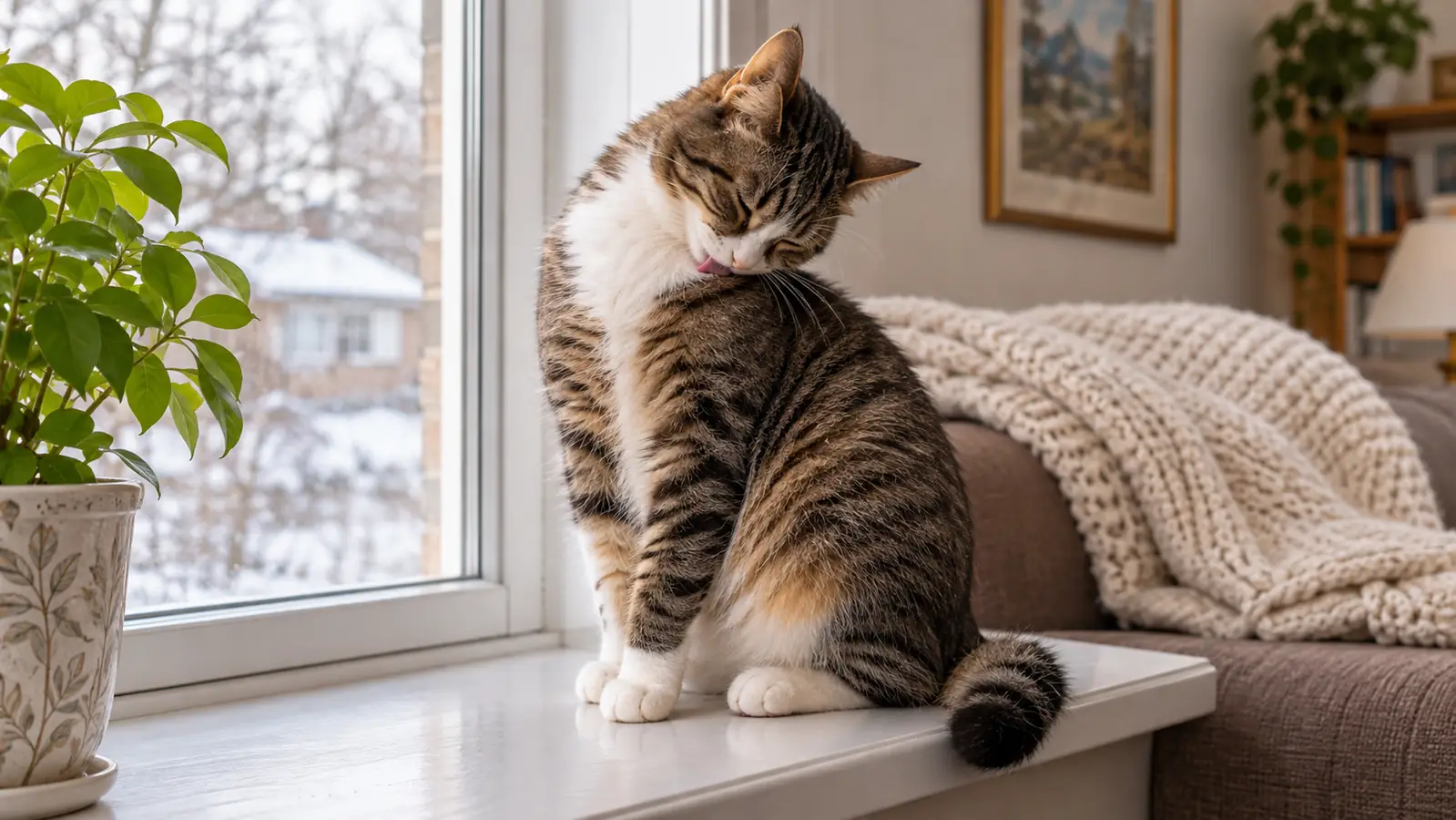
Pepper left the first hairball of the season on the bath mat at 5:40 on a Tuesday morning, roughly four minutes before my alarm. She is nine, a gray domestic shorthair, about eleven pounds, indoor only, and the pickiest eater in a house that also contains an eleven year old beagle mix who would eat drywall if I let him. Every winter her coat goes dull and flaky across the back, and every winter I sweep up more fur than seems physically possible from an eleven pound animal. I tried the usual things first. I brushed her more often, which helped a little and annoyed her a lot. I tried the petroleum gel you smear on a paw, which she shook onto the kitchen floor and then sat down and stared at me about. I bought a drugstore chew she sniffed once and never touched again.
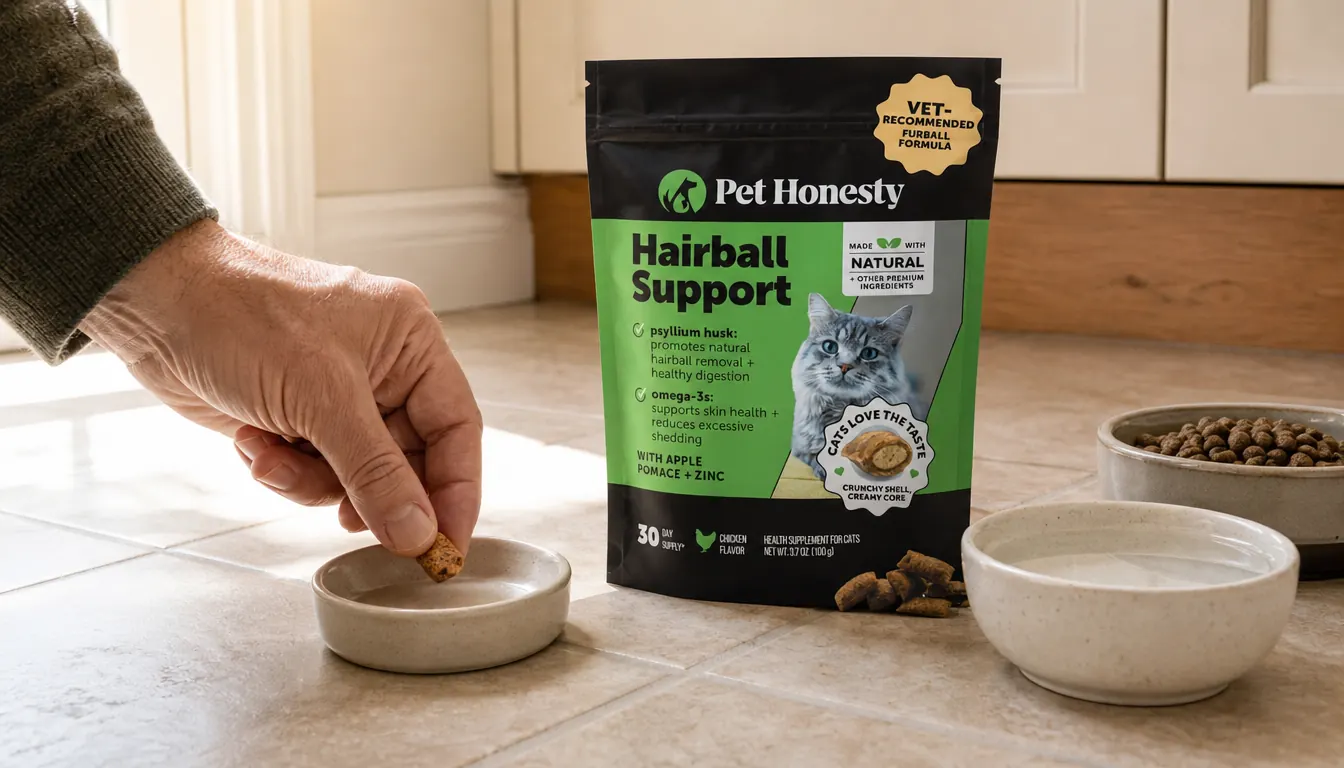
What finally moved the number was a bag of Pet Honesty Vet Backed Cat Hairball Remedy Chews, and it moved the number slowly, which is the only kind of change I trust. They are chicken flavored crunchy bites with a dual texture, and the active ingredients on the label are things I can actually read out loud: psyllium husk, apple pomace, citrus pulp, zinc methionine, and omega-3s from fish oil and lecithin. The bag is sold as a 30-day supply and the formula is non-GMO. Before any of that matters, though, one thing has to happen first, and it is the step most people skip. Call your vet. Especially if your cat takes any medication at all. I will explain why in a minute, and then I will give you the other four steps in the order I would do them again.
The Chew Pepper Stopped Sniffing and Started Eating
Chicken flavor crunchy bites with psyllium husk, apple pomace and omega-3s from fish oil. Sold as a 30-day supply, rated 4.6 from more than 7,700 reviews on Amazon. Read the label for the amount that matches your cat's weight, and ask your vet first.
Amazon Check Today's Price on Amazon →Step 1: Clear It With Your Vet Before You Open the Bag
I put this first because it is first. Call your vet before you buy, not after. I spent nineteen years behind the front desk of a small animal clinic and I lost count of how many times someone mentioned a new supplement in passing at the end of a visit, three weeks after the cat had started it. That conversation is easier to have in reverse.
There are two reasons. The first is that hairballs are not always only hairballs. A cat who brings up a tube of fur every week or two is one situation. A cat who vomits food, loses weight, goes off dinner, or coughs and retches without producing anything is a different situation, and that cat needs an exam, not a chew. The second reason is the fiber itself. Psyllium husk and the fruit fibers in this formula do what fiber does, which is move contents along. If your cat is on medication, your vet wants to know a new fiber source entered the picture.
You do not need a full appointment for this. I called our vet's office, read the active ingredients off the bag over the phone, and got a yes for Pepper with one instruction attached, which was to keep an eye on her stools the first week. The call took six minutes. Make the call.
Step 2: Match the Amount to Your Cat, Not to the Bag
The label carries the real numbers, so read it before you get home and start guessing. The serving is set by body weight, and Pepper sits around eleven pounds, so I followed the line for her range and gave exactly that, once a day, at the same time each morning. The Pet Honesty bag is built as a 30-day supply, which is a useful anchor. If you feed the labeled amount and the bag lasts about a month, you are on plan. If it disappears in three weeks, someone in the house has been generous, and in this house that someone is me.
The other half of this step is keeping the bag away from the dog. Cat formulas are made for cats, and a beagle will absolutely help himself if the bag is left on the counter at nose height. Mine has stolen things far less interesting than a chicken flavored chew. Store it in a closed drawer or a high cabinet and put the bag away the second you have counted out the day's portion.
One more note on the counting. Do not eyeball it and do not top off yesterday's portion because you are not sure whether she got one. Write the day's serving down or set it out the night before. With a picky cat, you will spend enough energy just getting the chew into her, and you do not want to also be reconstructing the math from memory.
Step 3: Introduce It Like You Expect Them to Say No
Pepper's first reaction was to sniff the chew, look up at me, and walk to her bowl as though I had insulted the household. This is normal cat behavior, not a verdict. The Pet Honesty product page notes that in an independent feeding study, nine out of ten cats liked the taste of the dual texture recipe. Which means one in ten did not, and for the first week I assumed Pepper was the one.
What worked was a slow build. I broke one bite in half and set it on the plate beside her regular food, not on top of it. Cats are suspicious of anything that changes the surface of dinner. Two days of that, then a whole bite next to the food, then a bite alone in a small dish at the same time each morning. It took eight days before she ate it without the side-by-side arrangement, and now she is waiting by the dish.
Two things I would not do again. Do not crush it into the food, because a picky cat will smell the change and skip the whole meal, and then you have lost dinner and the chew. And do not follow the cat around the kitchen holding it out. Set it down, walk away, give it ten minutes, and pick up whatever is left without comment. The pressure is what convinces a cat the item is suspicious.

Step 4: Keep a Hairball Log for Four Weeks
I know how this sounds. Write it on the paper calendar on the refrigerator, not in your phone, because you will not open the app. Every time you find one, put a mark in the square. Every time you clean the brush, note whether it was one light pass or a full second cat's worth of fur.
Here is why the log matters. The change is gradual and your memory is not honest. Pepper went from roughly two a week in January to about one a week by mid-February to one in the last eleven days of the bag. Had I not been marking the calendar, I would have told you it did nothing, because the day I sat down to judge the results happened to be a day she produced one, and one is the number I would have carried around.
Four weeks is the honest window. Fiber and coat oils work on the fur already in the pipeline, and fur takes time to travel through a cat. Anything that claims to end hairballs in three days is selling you something else. What you are looking for in the first month is a lower count and, if you are lucky, a coat across the back that feels less like straw and more like a coat.
Nine out of ten cats ate it in the independent feeding study. In my kitchen the first week, the score was one gray cat, zero chews eaten, and a beagle who was extremely interested in the outcome.
Step 5: Decide at the End of the Bag, Not the End of the Week
When the bag runs out, sit down with the calendar and answer three questions honestly. Is the count lower than it was in January? Does the coat feel better under your hand? And did the cat eat the chew without a negotiation every single morning?
If two of those are yes, reorder. If only one is yes and it is the eating one, you have found a treat your cat enjoys, not a hairball plan, and it is worth a call to your vet about what else to try. If none of the three are yes, you are done, and you found out for the cost of one bag instead of the cost of a year of guessing. That is a fair trade in my book. Nothing works for every cat, and a supplement that does not work for yours is not a failure on your part.
Here is the unglamorous part, and I would be doing you a disservice to leave it out. A chew handles what the cat swallows. It does not handle what is sitting on the sofa, and it does not make a nine year old cat groom herself less. The month I stopped brushing because the bag was working, the count crept back up on me. Brushing twice a week is half of what changed the number in this house.
What Else Helps
Brushing is the cheapest thing on this list and the one people quit first. Ten minutes twice a week with a rubber curry brush that pulls the loose undercoat does more than any single product, because fur in the brush is fur that never reaches the stomach. Do it somewhere the cat already likes to sit, do it after dinner when she is sleepy, and stop while she is still enjoying it. A cat who associates the brush with being held down will hide under the bed the moment she sees it.
Water matters more than most people realize. Cats are famously poor drinkers, and a cat who is slightly dry has a harder time moving anything through. Pepper drinks more from a wide shallow bowl than from anything deep, and adding a spoonful of water to her wet food is the easiest thing I do all day. Winter air in a heated house also dries the coat out, so the flaking you see in January is partly the furnace. A humidifier in the room where she sleeps helped the flaking on her back as much as anything in a bag. And if your cat is vomiting food, losing weight, or retching with nothing coming up, put the chews down and call the vet. That is not a hairball problem, and no fiber source on the shelf will fix it.
Give It the Full Thirty Days Before You Judge It
One bag, one month, one calendar with marks in the squares. Chicken flavor crunchy bites with psyllium husk and omega-3s from fish oil, sold as a 30-day supply. Read the label, match it to your cat's weight, and clear it with your vet first.
Amazon See the Ingredient Panel on Amazon →