

I started giving Biscuit Nutramax Laboratories Cosequin in late February, after a cold snap turned our morning walk into a negotiation. He is an 11-year-old beagle mix, about 28 pounds, and he has been stiff in the back hips on cold mornings. Not lame. Not crying. Just slow to rise and careful on the porch steps. I spent 19 years as the front-desk manager at a small-animal clinic, so I know what a joint supplement can and cannot do. I also know how easy it is to buy a bottle, use it for ten days, and decide it did nothing. This time I kept notes. The bottle I used is the 132 count chewable tablet from Nutramax Laboratories. I am not going to tell you it turned him into a puppy. I am going to tell you what changed, what did not, and who I think should skip it.
Biscuit was rescued at age 3, and he has the typical beagle mix appetite, which helps with any chewable. He also has a sensitive stomach if his food changes, so I introduced this tablet the same way I would introduce any new food: one at a time, with his regular breakfast, and no other changes that week. Our vet knew I was starting it. That last part matters more than any review, including mine. If your dog is on medication or has kidney or liver issues, call your vet before you open the bottle. I am a retired front-desk manager, not a veterinarian.
The Quick Verdict
A plain, consistent glucosamine and chondroitin tablet that made Biscuit's morning rise easier by the fourth week. It did not replace our vet's plan, and it took patience.
Amazon Check Today's Price →The bottle I reordered, not the one I left in the cabinet
Biscuit takes the 132 count chewable tablets from Nutramax Laboratories. I track the count on the lid so I know when to reorder, and I keep the bottle by his food bin so I do not forget. If your dog is stiff on cold mornings, this is the first joint supplement I would ask your vet about.
Amazon Check Today's Price on Amazon →How I've Used It
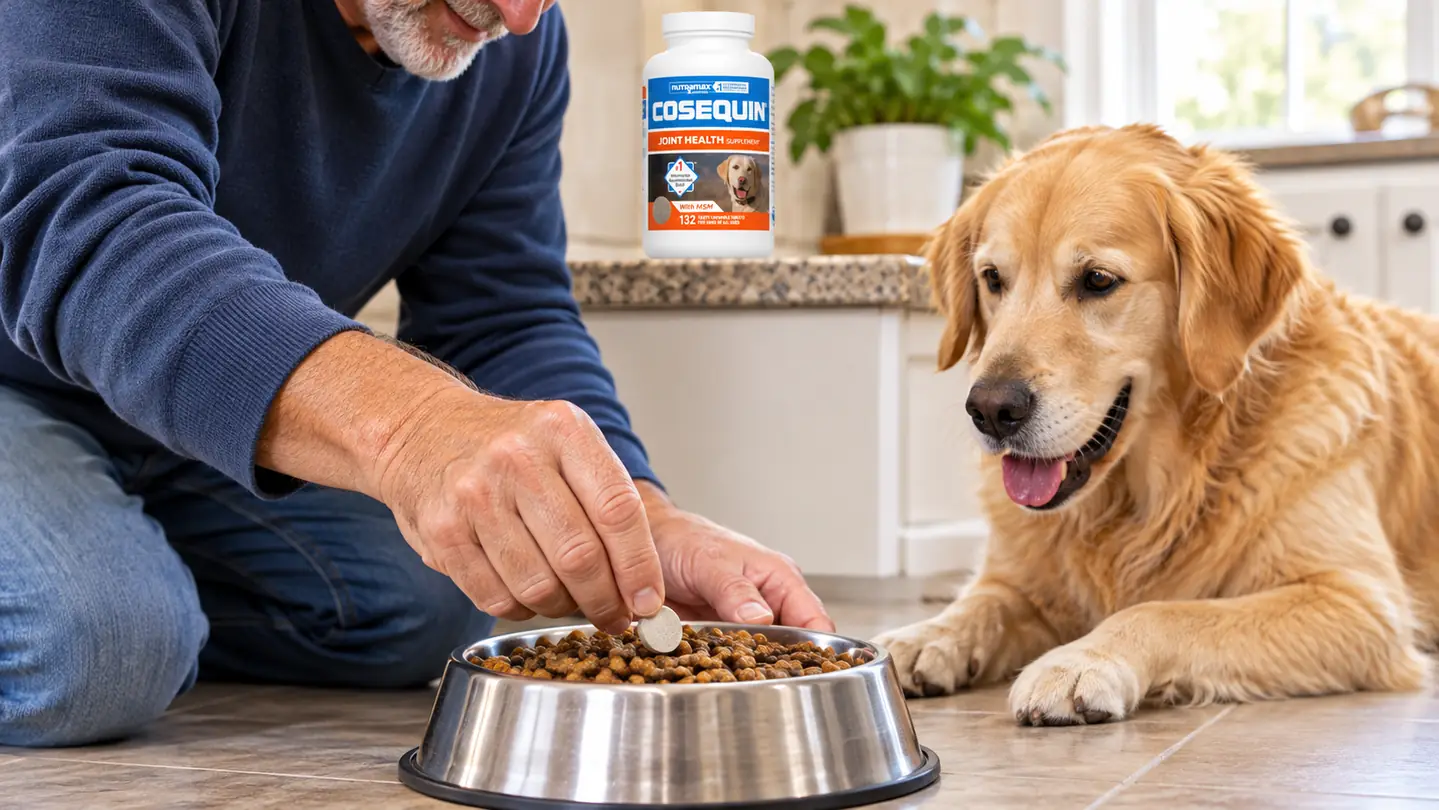
I started on a Tuesday morning in late February, after Biscuit took three tries to get up from his bed. I put the tablet in his stainless bowl with his kibble. He ate it. I wrote the date on a sticky note and stuck it to the inside of the cabinet door. Every morning after that, I gave it the same way, at the same time, with the same food. No new treats. No new kibble. No new walks on steep ground. If something changed, I wanted to know whether the tablet had anything to do with it.
The first two weeks were quiet. I do not mean that in a bad way. I mean there was no dramatic morning where he bounced off the floor. He was still slow. He still paused at the porch steps. I kept the log anyway. A supplement that works on joint cartilage is not a pain pill, and I have seen enough owners give up on day nine because their dog was not sprinting yet. I have been that impatient owner before. This time I gave it a full month before I made a judgment.
By the end of week four, I noticed the change in the small places. He got up from his bed in one motion instead of two. He stopped hesitating at the back door before the steps. On our flat morning walk, he pulled ahead to sniff a mailbox, which is a beagle thing and also a sign that he was feeling less careful. None of this was dramatic. It was the kind of change you only notice because you are watching for it. Dale noticed it too, without me pointing it out, which is the closest thing to a blind test in our house.
I kept him on the same amount our vet and the label called for. I did not double up on bad mornings. I did not skip days because he seemed fine. Consistency is the whole game with this kind of supplement, and the 132 count bottle made it easy to see how many tablets I had left. I wrote the start date on the lid with a marker. That sounds like a small thing. It is the difference between a real trial and a vague memory.
What Changed, Week by Week
Week one and two: nothing I could point to. His appetite was normal. His stool was normal, which mattered because of his sensitive stomach. He still needed a nudge to get off the rug in the morning. I would have told you the tablet was doing nothing, and I would have been wrong to stop there.
Week three and four: the morning rise got easier. He started sleeping through the night without shifting every hour. On a cold, damp morning, he walked to the door without the little hitch I had come to expect. I am not saying the tablet cured him. I am saying the trend line moved in the right direction at the point where I would expect a joint supplement to start earning its place.
Month two and three: the porch steps stopped being a debate. He still takes them one at a time. He is 11. He is not going to take them like a two-year-old. But he stopped standing at the top and thinking about it. On our flat walk, he kept a steadier pace. He was less stiff after lying down for a long time. Those are the wins I care about at his age. I do not need him to run. I need him to get up, go out, and come back in without looking like it costs him.
Month four and five: the changes held, but they did not keep climbing. This is important. Cosequin is not a drug that gets stronger the longer you use it. For Biscuit, it looked like a floor under his bad days, not a ramp to a new level. The cold mornings were still slower. The long naps still left him stiff for a minute. The difference was how long the stiffness lasted and how much it bothered him.
What's Actually in the Tablet
The label lists glucosamine hydrochloride, sodium chondroitin sulfate, and MSM. The listing also names the specific forms FCHG49 and TRH122, which is the kind of detail I used to hear from company reps at the clinic. I am not going to pretend I can read a study and tell you the exact ideal dose for a 28 pound beagle mix. What I can tell you is that this is the combination our vet was least surprised by when I brought it up. Glucosamine and chondroitin are the standard pair for joint support. MSM is the add-on that some owners swear by and some dogs do not need.
Cosequin is a chewable tablet, not a soft chew, and the bottle is 132 count. That matters for two reasons. First, a tablet is easy to count. Second, you can see what is left without guessing. I know exactly how many tablets remain in the bottle, which is more than I can say for the soft chews I tried years ago. Biscuit takes his with breakfast without a fight. If your dog is a gulper, watch him. If your dog is a nibbler, crumble it into the food and make sure it is gone.
Nutramax Laboratories has been a leader in pet health for over 25 years, and the listing calls Cosequin the number one vet recommended retail joint health supplement brand. I do not buy a product because of a line on a label. I do pay attention when a company has been around that long and a clinic I worked at stocked the brand. That is not proof it will work for your dog. It is a reason I was willing to try it for eight weeks instead of three days.

The Tradeoffs I Live With
It is not a pain medication. On a bad day, Biscuit still needs his vet's plan, not another tablet. If your dog is yelping, refusing to eat, or dragging a leg, this is not the thing you reach for first. I have seen owners wait too long because they wanted a supplement to be enough. It is not enough on its own for a dog in real pain. It is a support piece.
It takes time. I did not see anything I could call a change until week four. If you are the kind of person who needs a visible result in seven days, you will be disappointed, and you will blame the product. I would rather you save your money than run a two-week trial and call it a failure. It is a recurring cost, and I am not going to quote a price because it moves. Check today's price before you decide.
The tablet is not a treat. Biscuit is food motivated, so he takes it. A pickier dog might spit it out. If that happens, do not chase the dog around the house with a pill. Ask your vet about how to give it, or whether a different form is a better fit. I have no patience for a supplement that turns breakfast into a wrestling match. That is not a knock on this product. It is a knock on the idea that every dog will take every tablet the same way.
The 132 count bottle is a commitment. You are not buying a sample. You are signing up for a daily habit for a few months. I like that because it forces a real trial. I dislike it because if your dog's stomach does not agree with it, you are left with a bottle. That is why I introduced it slowly, with food, and watched his stool for the first week. A sensitive dog is not a good candidate for a cold-turkey start.
What I Liked
- Biscuit's morning rise got easier by week four, and the change held.
- The 132 count bottle makes a daily habit easy to track.
- Glucosamine, chondroitin, and MSM in one chewable tablet, with no extra powder to mix.
- Biscuit's sensitive stomach handled it when introduced with food.
- Nutramax Laboratories has a long track record with clinics.
Where It Falls Short
- Not a pain medication and not a substitute for vet care.
- Took about four weeks before I could point to a change.
- A picky dog may not take a tablet as readily as a soft chew.
- It is a daily commitment, not a one-week trial.
- You need to watch a sensitive dog's stomach at the start.
By week four, Biscuit was getting off his bed in one motion instead of two. That was the whole review, in one sentence.
Who This Is For
This is for the owner of an older dog who is stiff, slow to rise, and still moving, not a dog in acute pain. Biscuit is 11, about 28 pounds, and his hips have been creaky on cold mornings. If that sounds like your dog, and your vet has cleared a joint supplement, Cosequin is a reasonable first thing to try. It is also for the owner who will actually give it every day for a month. Half a bottle and a vague memory will not tell you anything.
It is for the owner who wants a tablet they can count and a label they can read. It is for the owner who is already using other pieces, like a soft bed, a flat walking route, and an honest conversation with the vet about weight and exercise. If your dog is carrying extra weight, that matters more for his hips than any supplement.
Who Should Skip It
Skip it if your dog is in serious pain, is limping badly, or has a sudden change in mobility. That is a vet visit, not a supplement. Skip it if your dog has kidney or liver issues, is on medication, or is already on another joint product with glucosamine and chondroitin. Doubling up is not a smart way to get a faster result. Ask your vet what is already in the bowl.
Skip it if you will not give it daily for at least a month, or if you expect a pain pill. Skip it if your dog is a picky eater and you are not willing to try a different form if he refuses the tablet. Skip it if you are looking for a guarantee. I cannot give you one, and neither can a label. What I can tell you is what happened with Biscuit, and that is the only claim I am willing to make.
If Biscuit's slow morning rise sounds familiar
Start with your vet, then decide. The bottle I keep on the counter is the 132 count chewable tablet from Nutramax Laboratories. I track the count, I give it with breakfast, and I do not expect it to do more than support the plan we already have.
Amazon Check Today's Price on Amazon →