

Pepper left a hairball on the good rug at 4:40 in the morning, and I stood there in the dark with a roll of paper towels deciding that something had to change. She is 9 years old, a gray domestic shorthair, indoor only, about 11 pounds, and she has been leaving those gifts on the carpet two or three times a month since she turned six. I spent nineteen years behind the front desk of a small animal clinic, so I know the speech by heart: brush the cat, add fiber, call us if she stops eating or starts losing weight. I had done the brushing. I had not tried a chew built for the job. This is my month with Pet Honesty Hairball Remedy Chews, given daily to one very picky cat in a one-story house outside Chattanooga.
I am not a veterinarian. I answered phones, scheduled appointments, and learned which questions to ask before a client got walked back to a room. So take this as one household's notes rather than a clinical trial. But I do read a label, I do write things down, and after nineteen years I can tell when a cat has genuinely changed and when I am just hoping she has.
The Quick Verdict
Three hairballs in the four weeks before, one during. Her winter coat stopped feeling like straw by week three. The catch is the tub: 3.7 ounces does not stretch far if you have more than one cat.
Amazon Check Today's Price →The chew Pepper finishes before she walks away from the bowl
A 30-day supply of crunchy chicken bites with psyllium husk, apple pomace and omega-3s. Rated 4.6 stars across more than 7,700 reviews.
Amazon Check Today's Price on Amazon →How I've Used It
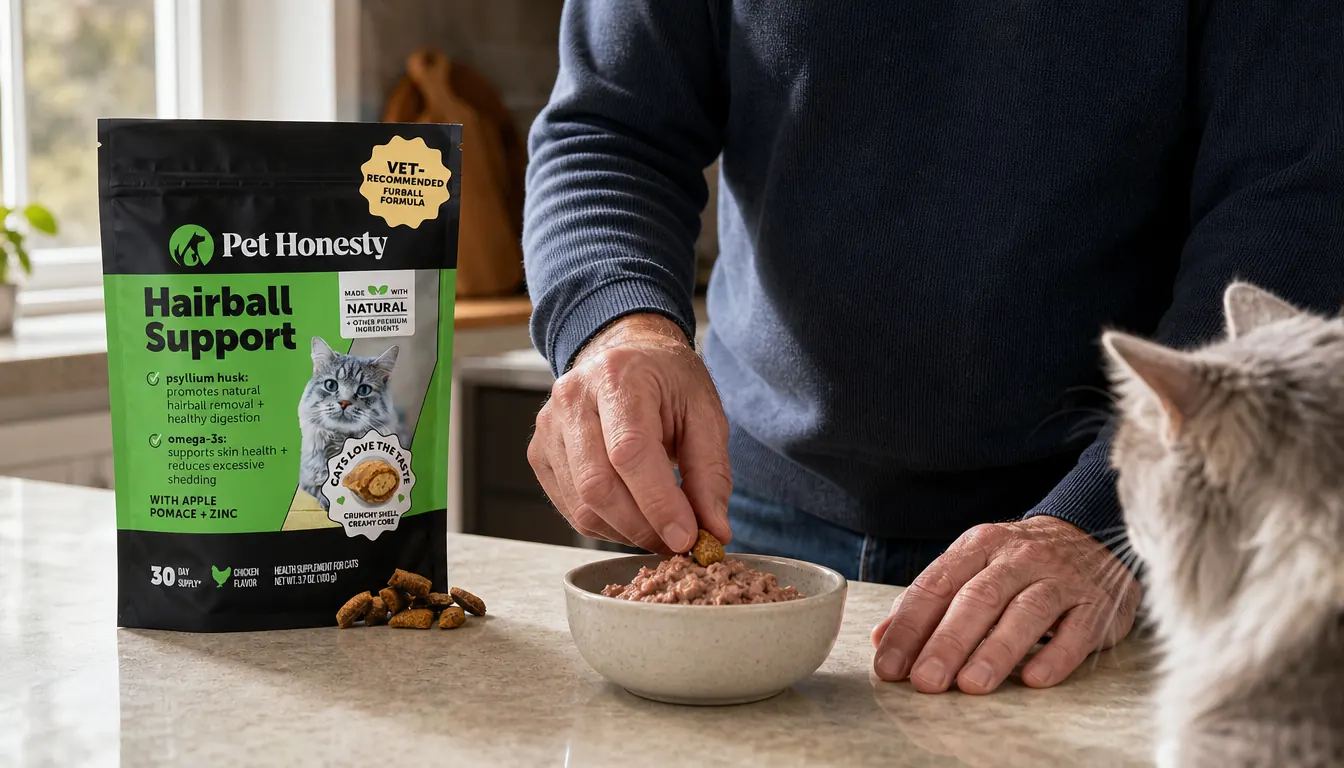
The tub is small, roughly the size of a coffee mug, and the label lists it at 2 by 5 by 7 inches and 3.7 ounces. It is sold as a 30-day supply, and I followed the directions printed on the container rather than inventing a schedule of my own. Pepper eats breakfast at 6:30 and dinner around 5, and the chews went on top of the evening meal because that is the meal she actually finishes. I did not crush them, I did not hide them in anything, and I did not free-feed them in a bowl on the floor, because a bowl of chews sitting out all day is a bowl of chews a cat can decide she is too good for.
We also have Biscuit, an 11-year-old beagle mix, about 28 pounds, rescued at age 3. He has a sensitive stomach and stiff back hips on cold mornings, and he does not get cat chews, no matter how convincingly he sits. The tub lives on the kitchen counter beside the coffee maker, pushed back far enough that a beagle with a good nose and bad hips cannot reach it. That is the whole reason it survived week one.
I taped a sheet of paper to the inside of the pantry door and wrote down five things every evening: the date, whether a hairball appeared, how her coat felt along the spine, whether she cleaned her bowl, and anything unusual in the litter box. Four weeks is not a long study. It is long enough to notice a trend in a cat who had been running two or three hairballs a month for three years, which is the only claim I am making here.
A word on how the four weeks were actually set up, because the setup is the part people skip. I started on a Sunday, November 9, for no better reason than that I had a clean sheet of paper and a fresh tub on the counter. The four weeks of comparison data came from the four weeks immediately before that, which is why I can give you the three dates in October and early November later in this piece. Same food, same water bowl, same litter, same house. The only thing I changed was the chew. I did not start brushing her more often during the test even though I wanted to, because if I had changed two things at once I would have learned nothing about either one. That is the single most useful habit I brought home from the clinic: change one thing, write down what happens, and give it long enough to show up.
What's Actually in the Chews
The label lists citrus pulp, apple pomace, psyllium husk, zinc methionine, and omega-3s from fish oil and lecithin, in a chicken-flavored crunchy bite. That combination is not mysterious. Psyllium husk and apple pomace are fiber, and fiber is the blunt, useful tool here. Hair that a cat swallows while grooming normally moves through the gut and out the other end. When it does not, it collects in the stomach, irritates the lining, and eventually comes back up in the shape of a cigar. Fiber helps keep the first path moving. Citrus pulp adds to that fiber load.
Zinc methionine and the omega-3s are aimed at skin and coat rather than at the hairball itself, which matters more than it sounds. A cat with a dull, flaky coat is a cat grooming more, swallowing more loose fur, and producing more hairballs. The listing also mentions antioxidant, digestive, immune and skin support, which is a wide net for one small bite. I care about the fiber and the coat. Those are the two I can see with my own eyes.
The listing notes the formula is non-GMO, and it says this is the top hairball supplement on Amazon. I would not buy anything on that sentence alone. What I would say is that the ingredient list is short and readable, and I did not have to look up four things I could not pronounce. If your cat has food sensitivities, the flavor is chicken and there is fish oil in the formula, so read the label with your vet before you order.
I did go back and read the ingredient panel a second time with a pen in my hand, the way I used to read labels at the desk when an owner asked me whether a bag of food was any good. What struck me is what is not on it. There is no long tail of gums and dyes that tell you nothing. The fiber sources sit near the front, which is where you want them if fiber is the reason you are buying. The vitamin and mineral side is a supporting cast and not the headline, and that is right for a hairball product. I have seen tubs that put a photograph of a glossy cat on the front and bury three milligrams of the one useful thing at the bottom of the panel. This is not that. It is a short formula doing one job with a couple of small helpers alongside it, and after nineteen years of watching owners buy hopeful things, I have come to prefer short formulas that admit what they are.
What Changed Over Four Weeks
The first week, nothing happened. I want to be clear about that, because reviews that describe a turnaround by Tuesday are not describing my cat. Pepper ate the chews when they were sitting on her wet food, she ignored them when they were not, and her coat felt exactly the same as it had the week before. The pantry sheet for those seven days has one hairball on it and no other notes.
The coat changed first, somewhere in the second week. Pepper gets dull and flaky in the cold months, and the fur along her spine had that rough, dry feel she gets every November. By the third week it was smoother, and the flakes at the base of her tail had mostly cleared up. I cannot tell you whether that was the omega-3s, the zinc methionine, the furnace running less, or simply the calendar. I am reporting it, not claiming credit for it.
The hairballs are the number that matters. I counted three in the four weeks before we started, on October 14, October 22 and November 2. During the four weeks on the chews I counted one, and it was smaller and looser than what she usually brings up. Not zero. One. In a cat who had been on a two-or-three-a-month schedule since she was six years old, one in a month got my attention, and it is the reason the tub is still on the counter.
Three hairballs in the four weeks before we started. One during. And that one was smaller and looser than anything she had produced in three years.
Two things did not change, and I would rather tell you than have you find out yourself. Her appetite is identical, which is good, and her litter box habits are identical, which is also good. And she still coughs now and then after she grooms, the dry, raspy little cough that is not a hairball yet. Nobody should read this and expect their cat to stop coughing entirely.
If you want the day-by-day version, here is the closest thing I have to it. Days one through seven: one hairball, on the Tuesday, and a coat that felt like the week before. Days eight through fourteen: no hairballs, and on the Saturday I noticed the fur behind her ears had stopped feeling greasy when I petted her. Days fifteen through twenty-one: no hairballs, and the flaking at the base of her tail was gone by the Thursday. Days twenty-two through twenty-eight: the one hairball, on a Sunday morning, smaller than usual and not attached to the rug the way the October ones had been. Four numbers, four weeks, one page. That is the whole study. It is not elegant, but it is honest, and it is more than I could have told you from memory.
The Picky Eater Test
If you live with a picky cat, you already know the real question is not whether a supplement works. It is whether the cat will eat it long enough for you to find out. The listing says an independent feeding study found 9 out of 10 cats liked the taste. Pepper is not in that nine by temperament. She is in it by placement.
The first morning I set one bite on the kitchen floor beside her bowl. She sniffed it, looked up at me the way a cat looks at a person who has lost her mind, and walked off. The second morning I set the same bite on top of her wet food, and it was gone inside of three minutes. That has been the routine ever since, and in four weeks she has left exactly one behind, on a night when I put it at the edge of the bowl instead of the middle.
The bites are crunchy, and the listing describes the recipe as dual texture. Whatever the second texture is, she does not leave crumbs, which is more than I can say for the pill pockets I used to hide her medication in. For a cat with a picky history, that is the difference between a supplement that gets used and a tub that sits in the cabinet until it goes stale.
I tried three other ways of delivering them in that first week, in case you are wondering, and two of them failed outright. Crumbled over dry kibble was a no. Set on a saucer beside the water bowl, away from her food, was also a no, and she gave the saucer a wide berth for two days afterward as though it had personally insulted her. The one that worked was the simplest: one whole bite, right on top of the wet food, in the same spot every evening. Consistency did more than any trick. A cat builds a routine out of repetition, and by the end of week two she was waiting at the bowl before I had finished opening the tub.
Where It Falls Short
The container is 3.7 ounces and the label calls it a 30-day supply. In a one-cat house on the printed directions, that is honest. Add a second cat and you are reordering twice as often. And if your cat decides halfway through the tub that the bites are beneath her, which is a thing cats do, you are left with an open container and a decision to make. I would buy one tub first. Not two.
This is also not a fix for a medical problem. If your cat is bringing up something more than once a week, or vomiting without producing hair, or dropping weight, or going off food, that is a phone call to your vet and not a supplement purchase. In nineteen years at that front desk I watched a lot of people try to solve a thyroid problem with brushing. It never worked once.
One more tradeoff. The fiber approach is slow. Nobody is getting a result in three days, and if you quit at day five because nothing happened, you have wasted the tub and you will write a review saying it does nothing. Give it the full four weeks and write the dates down. Otherwise you will not be able to tell whether it helped or whether your cat simply had a quiet month.
And a small one that will not matter to everyone. The bites do have a smell, a fishy, faintly sweet smell that stays on your fingers for a minute after you handle them. I got used to it by the second week and now I do not notice. Dale noticed. He also noticed that the tub was taking up counter space beside the coffee maker, which in a small kitchen is prime real estate. Both of those are trivial against a cat who stopped leaving fur on the rug, and I would rather list them than have you open the container and wonder why nobody mentioned it.
What I Liked
- Pepper went from three hairballs in four weeks to one
- Coat along the spine felt noticeably smoother by the third week
- Crunchy chicken bites disappear into wet food, no crushing needed
- Fiber-first formula: psyllium husk, apple pomace and citrus pulp
- Small 3.7-ounce tub that fits on a kitchen counter
- 4.6 stars across more than 7,700 Amazon reviews
Where It Falls Short
- 3.7 ounces is a small container for a multi-cat household
- Pepper would not eat them dry from the floor, only as a topper
- No help in the first week, which is when most people quit
- Not a substitute for brushing or for a vet visit
- Chicken and fish oil make it a poor fit for cats with those sensitivities
Who This Is For
This suits an indoor cat in middle age or older who brings up a hairball every couple of weeks, especially one whose coat goes dull and flaky in winter. It suits a picky cat, as long as you are willing to use the chews as a topper on food she already likes rather than trying to hand them over. And it suits an owner who will keep a note for a month instead of judging the whole thing on a Tuesday. If you have one cat, a small tub, and a routine that already includes brushing, Pet Honesty fits in without rearranging anything.
It also suits the person who has already tried the free things and found them wanting. I brushed Pepper twice a week for two years before this, and brushing helped, but it never got her below two hairballs a month. That is the gap this filled for us. If your cat is at six or seven hairballs a month, a chew alone is not going to be enough and you should be talking to your vet about what else is going on. If your cat is at one or two, and brushing has already done what it can, that is the household I would hand this tub to.
Who Should Skip It
Skip it if your cat vomits more than once a week, or vomits without producing a hairball, or has lost weight, or has stopped eating. Those are vet visits, not supplements. Skip it if you have three or four cats and no interest in buying the small tub every ten days. Skip it if your cat has a known chicken or fish sensitivity. And skip it if what you actually want is a guarantee of zero hairballs forever, because no product does that and nobody honest will tell you otherwise. If you are undecided between this and the other option on the shelf, the comparison of Pet Honesty against Vet's Best is worth five minutes before you order anything.
Start with one tub and keep the same notes I kept
Thirty days, one cat, five lines a night on a sheet of paper. That is enough to know whether this belongs in your cabinet or your donate pile. Check with your vet first if your cat is on medication or has food sensitivities.
Amazon Check Today's Price on Amazon →