

Pepper is nine years old, eleven pounds, indoor only, and the pickiest cat I have ever fed. She turns her nose up at wet food that has been open more than a day. She gets hairballs in the spring and a dull, flaky coat every January. Our vet suggested an omega 3 fish oil, and after a lot of label reading I landed on Welactin for Cats from Nutramax Laboratories. I have used it daily for just over five months now. This is the honest version, including the parts that annoyed me.
Here is the short version. The coat change was real but slow. The hairball change was modest. The standoff at breakfast lasted about two weeks. And nobody at the store mentioned that a four-ounce bottle feels small once you are measuring a daily dose. If you want the details that actually matter, keep reading.
The Quick Verdict
A legitimately useful omega 3 for coat and skin, if your cat will tolerate fish oil and you can commit to eight weeks of daily dosing. Not a hairball cure, and not a substitute for a vet visit.
Amazon Check Today's Price →Read the dosing chart before the first meal
Welactin is a liquid omega 3 with EPA and DHA, and it comes with its own scoop. Check the current listing and read the label for your cat's weight.
Amazon Check Today's Price on Amazon →What Nobody Tells You Before You Buy
The first thing nobody tells you is the smell. Fish oil smells like fish oil. If you have a cat who inspects every bowl like a food critic, you will notice. I opened the bottle in the kitchen and Pepper left the room. That is not a defect. It is the product being exactly what it says it is.
The second thing is that this is not a treat. Some supplements come as a chew a cat will take from your hand. Welactin is a liquid, and the listing says it includes a scoop for dispensing. You are measuring it and putting it on food. That means the food has to be something your cat already likes enough to finish. With Pepper, that was a teaspoon of pate, not her dry kibble.
The third thing is the timeline. Skin and coat support is not an overnight change. The omega 3s in this product support skin and coat health, plus kidney, brain, vision and overall wellness, according to the listing. In real life, I saw the first difference in Pepper's coat around week five. Anyone promising a new cat in seven days is selling you something else.
The fourth thing is that this is a supplement, not a treatment. If your cat is scratching herself raw, losing fur in patches, or drinking more water than usual, that is a vet visit, not a bottle of oil. I say that as someone who spent nineteen years watching people try the bottle first and the vet second. The order matters.
The label calls this a rich source of omega 3 fatty acids, with EPA and DHA as the active ingredients. It lists skin and coat health, kidney health, brain health, vision health and overall wellness. It also puts joints and hip under specific uses, though Pepper does not have a joint issue, so I cannot speak to that part. It says the brand is the number one vet recommended omega 3 supplement brand, which is a claim from the maker, not a promise about your cat. What the label does not say is how fast you will see anything. It does not say your cat will stop shedding. It does not say this will fix a hairball problem. I appreciate that, even if I wanted more certainty. A label that promises less is easier to trust.
Our vet was the one who suggested an omega 3 in the first place, and she did not name a brand. That is usually how it goes. She said to look for EPA and DHA and to start with a form the cat would actually take. Nutramax Laboratories makes a liquid with both, and that is why I tried this one instead of a capsule.
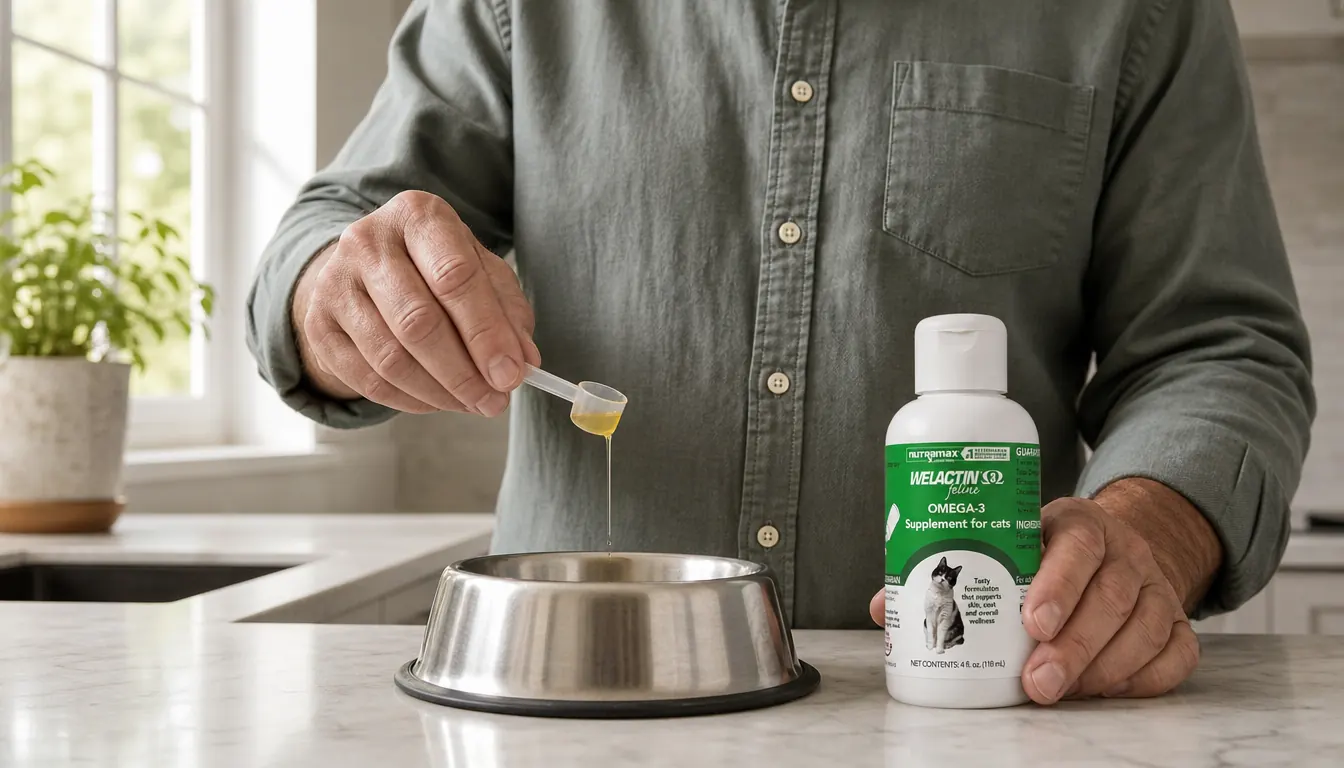
How I Tested It on a Cat Who Turns Her Nose Up at Everything
I started on a Monday in early November, right when Pepper's coat gets its winter dullness. I weighed her at the vet's office before we started, eleven pounds on the nose. Every Sunday I wrote down three things: how the fur felt along her spine, how many hairballs I found that week, and whether she finished her breakfast.
For the first two weeks I mixed the oil into half a pouch of her usual wet food. She ate around it. Not refused, exactly, but she left the edges of the food that had touched the oil. By the third week I warmed the wet food in my hand for a few seconds, mixed the oil in, and put it down. That worked. The warmth seems to dull the smell enough that she stops investigating.
I did not change her dry food, her litter, or her grooming routine. That matters. If you start a new supplement and a new food in the same week, you will never know which one did what. One change at a time is slower, but it is the only way to learn anything.
If you take one thing from this review, take this. The first two weeks are a negotiation, and most people quit there. The cat is suspicious, the food smells different, and you are sure you wasted your money. I nearly did. What saved it for us was warm wet food and a smaller portion, so she was hungrier and less picky. If your cat refuses the food entirely, do not force it. Try a different wet food, or a lickable treat, or ask your vet for a different form of omega 3. A cat who stops eating is a medical problem, not a training problem.
I also took a photo of her coat in the same window light on day one. I am not a photographer, and the photo is blurry, but it is still better than my memory. By week six I was second-guessing whether the shine was new. The photo settled it.
The Dosing Part Nobody Warns You About
The bottle is four ounces. That sounds like plenty until you are measuring a small amount every day. I used the scoop that came in the box and leveled it with the back of a butter knife. Eyeballing a drizzle is not the same as measuring, especially with a cat who weighs eleven pounds.
The dosing chart is based on weight, and Pepper sits on a line where a small change in the scoop matters. I am not going to give you her exact amount, because your cat is not my cat and the label is the label. What I will tell you is to read it with your glasses on and write your cat's amount on a sticky note for the fridge. I got it wrong once in week two and only caught it because I was keeping the log.
The other thing nobody says out loud is that fish oil does not belong in a bowl that sits out all day. I mix it fresh at breakfast and wash the bowl right after. If Pepper does not finish, the bowl goes in the sink, not back on the floor. That is basic food safety, not a knock on the product.
And if your cat is on any medication, ask your vet before you start. Omega 3s are generally well tolerated, but generally is not the same as always, and your vet knows your cat's history better than a label does.
I keep the bottle in a cabinet, not on the counter, and I wipe the neck after every use so the cap does not get sticky. That is not advice from the label. It is just what keeps the bottle from turning into a mess.
What Actually Changed, Week by Week
Weeks one and two: nothing good. She was suspicious, I was annoyed, and the only change was that breakfast took longer. Week three: she started finishing the small wet food portion again. Week four: the dandruff along her spine was still there, but the skin under it looked less dry when I parted the fur.
Week five is when I noticed the coat itself. It had a shine along her back that I had not seen since before she turned seven. Not a show cat shine, just less dusty and less flat. By week eight, the flaky patches near her tail base were mostly gone, and I was vacuuming less cat hair off the sofa, though that could be the season changing.
The hairballs went from roughly twice a month to about once a month. That is a real change for us, but it is not a cure. Pepper is a shorthair with a grooming habit, and hairballs are partly a mechanical problem. The omega 3 helped the coat, and a healthier coat means less shedding and maybe less swallowed fur. It did not stop the spring hairball entirely.
Her appetite did not change. Her energy did not change. She is nine, and she still sleeps in the same sunbeam on the same chair. I mention that because coat and skin are the visible things, and it is easy to talk yourself into seeing more than is there.
Her weight stayed at eleven pounds. I checked it again at the three-month mark. That matters to me because a supplement that quietly adds calories is not a neutral thing for an indoor cat. This one did not change her weight.
What did not change: her water intake, her litter box habits, and her opinion of the vacuum. I did not expect any of those to change, and they did not. I am listing them because a review that only reports the wins is not a review.
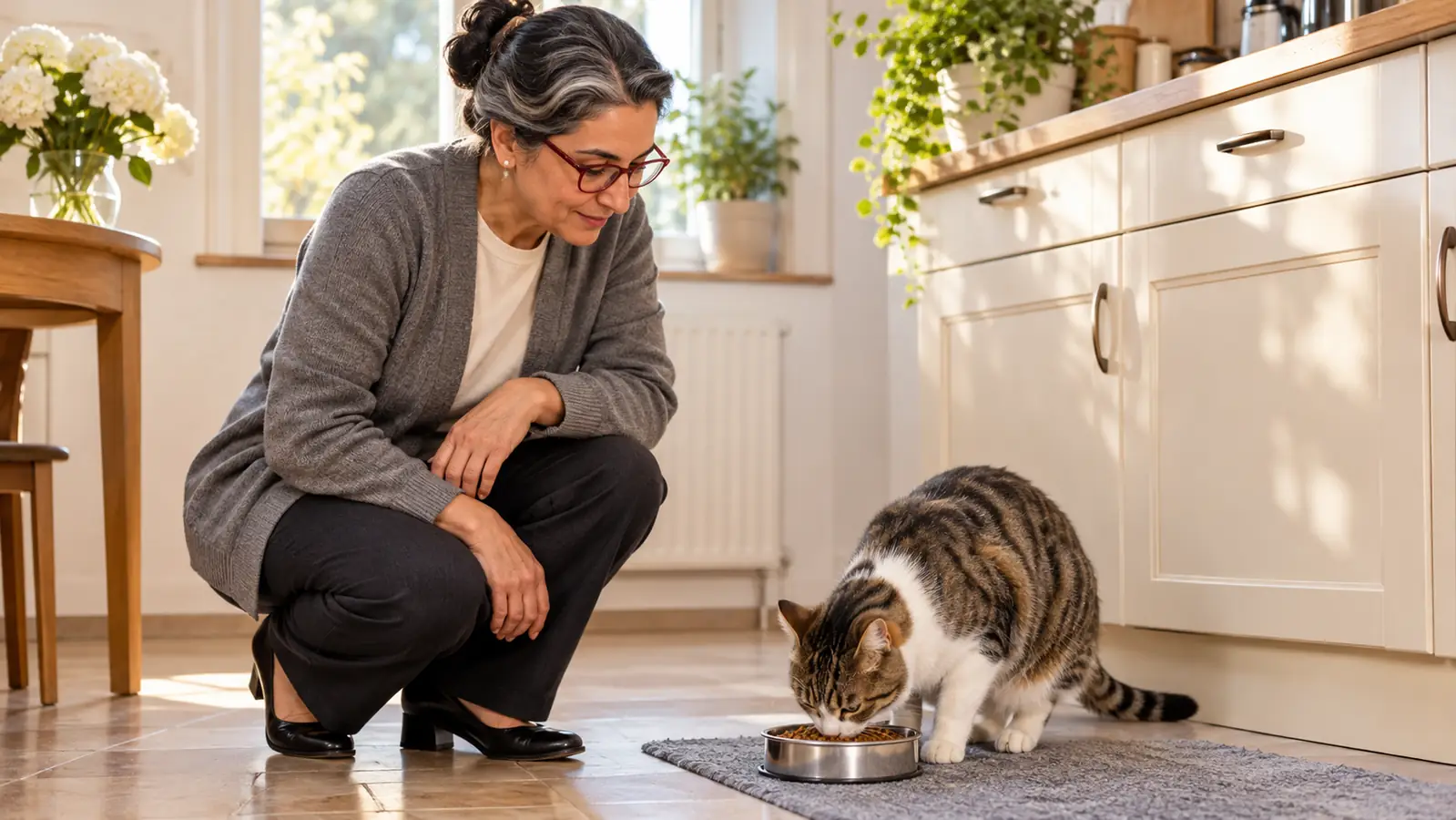
The Parts I Don't Love
The smell is the obvious one. I keep the bottle in a cabinet away from the coffee, and I wipe the neck after every use. If you are sensitive to fish, you will smell this. The scoop is small and easy to lose in a drawer, so I keep it inside the bottle cap.
The four-ounce size feels smaller than you expect for a daily supplement. I am not going to pretend I know how long a bottle lasts for your cat, because that depends on the dose. I can tell you that daily use adds up, and I wish the label made the number of servings per bottle more obvious at a glance.
I have tried fish oil capsules for cats before, and I gave up. You cannot hide a capsule in a cat's food without the cat finding it. A chew is easier if your cat likes chews, but Pepper does not. The liquid is the only version that lets me measure a dose and mix it into something she will actually eat. The tradeoff is that liquid is messier and smells stronger. A capsule is neat and odorless until the cat bites it, at which point you have a bigger problem.
I would start with a smaller wet food portion from day one. I wasted two weeks putting the oil on a full pouch, and she ate around it. A teaspoon of pate with the oil mixed in, followed by the rest of her breakfast, would have saved us both some grief. I would also ask the vet at the start whether this was the right form for her, instead of waiting until the first checkup. I got lucky. The next person might not.
Would I buy it again? Yes, for Pepper, for another winter. Not because it changed everything, but because the coat change was real and the routine is now easy. That is a lower bar than a lot of reviews set, and it is the honest one.
What I Liked
- EPA and DHA in a liquid form that mixes into wet food
- Includes a scoop for measuring, which matters more than it sounds
- Real improvement in coat shine and flaking after about five weeks on Pepper
- A brand many vet clinics know, from Nutramax Laboratories
Where It Falls Short
- Strong fish smell that some cats refuse at first
- Liquid means you have to mix it fresh, not leave it sitting out
- The four-ounce bottle goes faster than expected with daily use
- No effect on Pepper's spring hairballs beyond a modest reduction
By week five, the coat along Pepper's spine had a shine I had not seen in two years. The hairballs went from twice a month to about once. That was the whole result, and for us it was enough.
Who This Is For
This is for the owner of a cat with a dull, flaky coat, especially in winter, who is willing to measure a liquid and mix it into wet food every day for at least two months. It is also for the owner whose vet has already suggested an omega 3 and who wants a liquid rather than a capsule or a chew. It is for the person who can keep a small log and not panic when week one looks like nothing. And it is for the owner who understands that a supplement sits alongside vet care, not in place of it. If your cat is on medication, ask your vet before you add any oil, including this one. That is not a disclaimer I am reading off a card. I spent nineteen years watching people forget to mention supplements to the vet, and it matters.
Who Should Skip It
Skip it if your cat will not eat wet food at all. You can try mixing this into a lickable treat, but a cat who refuses anything but dry kibble is going to be a hard sell. Skip it if you want a hairball fix. This supports skin and coat, kidney, brain and vision health according to the listing, but it is not a hairball remedy. Skip it if you are looking for a capsule you can hide in a pill pocket, because this is a liquid. And skip it if you are not going to measure. A drizzle from the bottle is not a dose, and a supplement you do not dose correctly is just oil on your cat's breakfast.
If your cat's coat needs help, start with the label and your vet
Welactin is a liquid omega 3 from Nutramax Laboratories, with EPA and DHA and a scoop in the box. Read the dosing chart for your cat's weight before the first meal.
Amazon See It on Amazon →