

Pepper turned nine this fall, and somewhere around the first cold snap her coat went flat. Not matted, not patchy, just dull, like a good wool sweater after one too many washes. When I brushed her in the evenings the brush came up with a fine gray fluff and a scatter of flakes along the base of her tail. She is an indoor cat, eleven pounds, and the pickiest eater I have ever fed. I spent nineteen years behind the front desk of a small animal clinic, so a dull winter coat is not a mystery to me.
Here is what I tried before I bought anything. A new food, which she refused for three days. Twice-daily brushing. A humidifier in the room where she sleeps. In October our vet ran bloodwork to rule out her thyroid and found nothing wrong with her skin except that it was dry. So I went looking, and I landed on Welactin for Cats from Nutramax Laboratories because it was the fish oil our clinic handed out most often and because it is a liquid I could stir into her food instead of a capsule she could spit onto the rug.
The Quick Verdict
Eight weeks of daily liquid fish oil took a dull, flaky winter coat to something you can actually see a sheen on, and cut the flaking at the base of her tail to almost nothing. It did not make her any less picky, and a four ounce bottle does not last forever.
Amazon Check Today's Price →If your cat's winter coat has gone flat and the brush keeps coming up gray, this is the bottle that sat in my fridge door all winter
Welactin for Cats is a liquid omega-3 fish oil from Nutramax Laboratories, with EPA and DHA and a scoop in the bottle. It stirs into a half can of pate in about four seconds.
Amazon Check Today's Price on Amazon →How I've Used It
We started on the twelfth of November, a Tuesday, because I had just come home with the bottle and I like to know exactly when a thing starts. There is a scoop in the bottle and the label tells you how much to give. I am not going to print the amount here. Your cat is not my cat, and dosing is a conversation with your vet, not a paragraph in somebody's blog post. Once I had the routine down, the whole job took about four seconds.
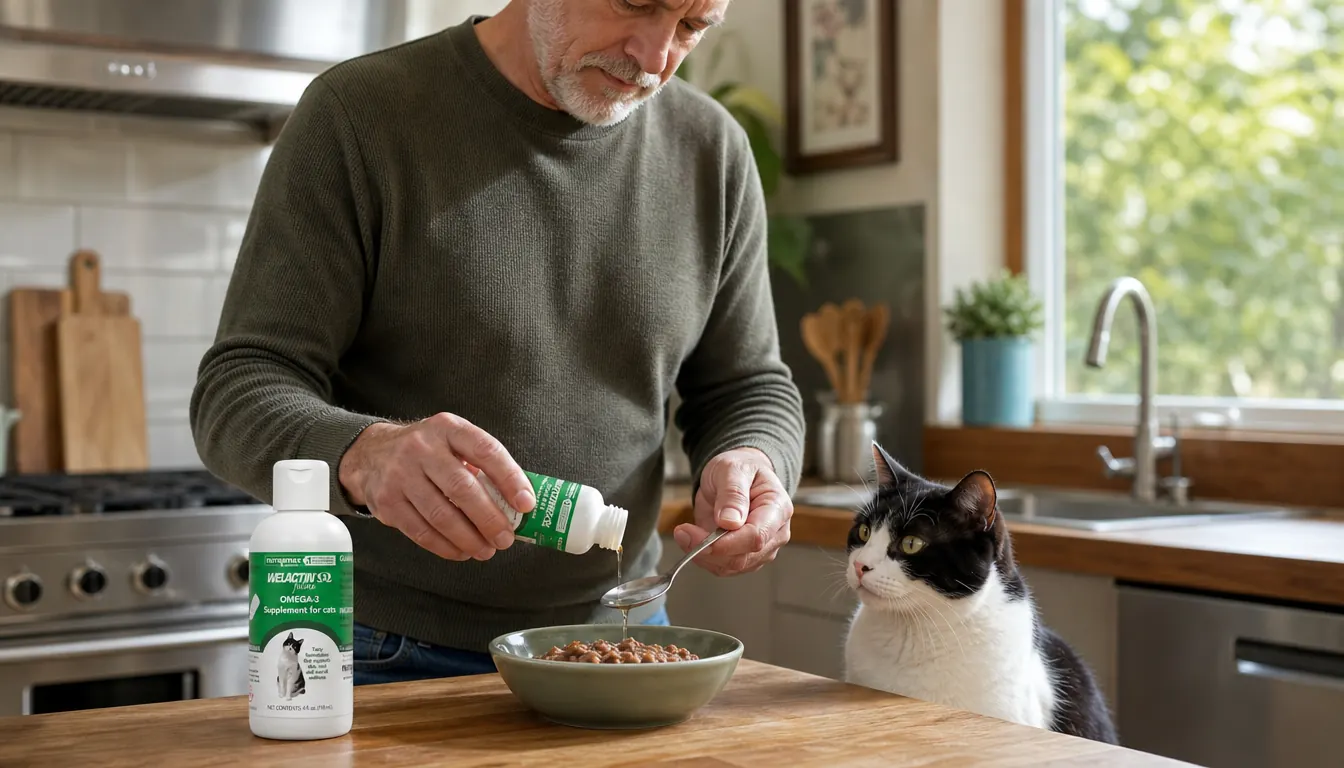
The routine is this. Half a can of pate in her dish, the oil on top, then a fork through it until the shine disappears into the food. Pepper is a cat who will walk away from a bowl that has been disturbed in a way she does not approve of, so I was braced for a standoff. She ate it. She has eaten it every day since, which I credit to the fish smell rather than to my technique. The first morning I did it the other way around, oil into the bowl first and the pate dropped on top of it, and she ate the food and left a ring of oil around the edge of the dish. That is how I learned to put the oil second and to fork it in for longer than feels necessary. Four seconds is the number now. It was closer to fifteen that first week while I worked out exactly how thoroughly the shine has to disappear.
The bottle lives in the door of the fridge, standing up, and it measures about 2.75 by 2 by 5.75 inches, which matters more than it sounds like it should when you are trying to fit a bottle in around the milk.
I kept a notebook. Every Sunday I wrote three lines: how much flaking I could see at the base of her tail, whether the brush came up clean or gray, and whether there was any shine on her shoulders when she sat under the lamp in the front room. Dale took over for four days in January when I had a cold and wrote the same three lines in his handwriting, which slants the other way. Neither of us missed a day. That is the real test of any supplement you bring into a house: whether the people in it can keep it up in week six.
The other half of the test is the cat. A supplement that gets refused is a supplement that gets poured down the sink, and I have poured more than one down the sink over the years. Pepper is eleven pounds and has never been a big eater. She leaves food in the bowl most days. She has not left this. That alone puts Welactin ahead of the last three things I tried on her, including the grocery store oil she licked once and then looked at me like I had insulted her.
What Is Actually in the Bottle
Welactin is a liquid fish oil supplement. The two things that matter in it are EPA and DHA, the omega-3 fatty acids that come up in every serious conversation about coats, kidneys, brains and eyes. The listing from Nutramax Laboratories says it supports skin and coat health, kidney health, brain health, vision health and overall wellness, and it carries a line about being the number one vet recommended omega-3 supplement brand. I cannot verify a ranking. I can tell you what I watched happen in one house in Tennessee over eight weeks, and I can tell you the label math is honest: it is fish oil, in a bottle, with a scoop.
What it is not is a cure for anything. I want to be plain about that, because the front desk is where I spent nineteen years watching people hope a supplement would do the work of a diagnosis. A dull coat in winter can be dryness, it can be age, it can be grooming, it can be thyroid, it can be kidney, it can be a cat who has decided she no longer likes the food she liked last month. Our vet ruled out the frightening ones in October. If yours has not, start there and not here.
I am also not a veterinarian. I answered phones, I booked appointments, I explained to people why the recheck mattered, and I read a great many labels while I did it. That is the whole of my authority. What I can offer is the piece nobody at the clinic could hand you: a daily record of one cat, in one house, over one winter.
The Coat Timeline, Week by Week
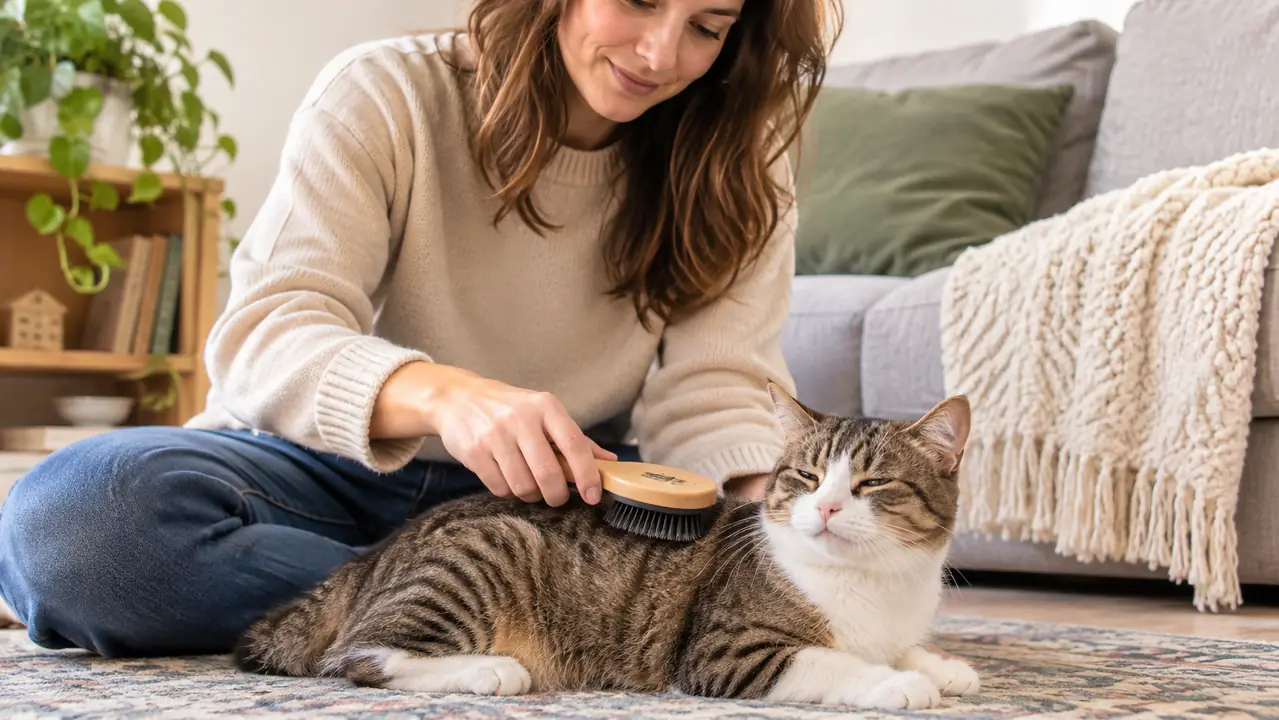
Weeks one and two, nothing. I want to say that first because a lot of reviews skip it. Her coat looked exactly the same on day fourteen as it had on day one, and I had already started composing the paragraph where I admitted I had wasted a winter. Week three is where the flakes at the base of her tail thinned out. Not gone. Thinned. When I brushed her, the brush came up with less of that fine gray dust, and the skin underneath looked less like it had been dusted with flour. I remember the date because it was the Thursday before Christmas and I had not wrapped a single present. I sat on the floor in the front room with her under the lamp and worked the brush along her spine in short strokes the way a technician at our vet's office showed me years ago, and when I held the brush up to the light there was maybe half of what had been there the week before. Half. Not a transformation, but not nothing either, and I wrote it down before I could talk myself out of it.
Week five, there was a shine on her shoulders. I noticed it the way you notice a thing you were not looking for, sitting on the floor next to her while the news was on. Week seven, the base of her tail was clear, and the brush came up with almost nothing. Week eight, which is where the notebook ends, she had a sheen down her back that I had not seen since she was about four. Not a show coat. She is nine and she sleeps sixteen hours a day. But the difference between November and January is the difference between a coat that looks tired and a coat that looks like a cat lives in it.
Weather matters and I will not pretend otherwise. We had a mild December and a cold January, and the January cold snap did not set her back the way the November one did. That could be the oil. It could also be that the furnace had been running for two months and the house had settled into its own winter routine. I am reporting what I saw. I am not proving a mechanism.
The Hairball Question
Pepper has always been a hairball cat. I keep a count on the back page of the notebook because our vet asked me to years ago and I never stopped. November: three. December: one. January: one. That is fewer than her usual winter, and her usual winter is three or four. I would like to tell you the oil did that. I cannot. I brushed her twice a day instead of twice a week for the same eight weeks, and every hair that goes on the brush is a hair that does not go down her throat. I also moved her water bowl off the wall and refilled it twice a day instead of once, which is old front-desk advice for a cat who is bringing things up, and I am not going to pretend that did nothing. If you want to credit the water, credit the water. What I know is the count went from three in November to one in December and one in January, and the two I found in December and January were smaller and looser than the ones she used to leave on the rug by the back door.
The listing does not make a hairball claim and I am not going to invent one on its behalf. What I will say is that a smoother coat sheds differently. It comes off on the brush in a sheet instead of in clouds, and the cat spends less of her evening working at her own back. Draw your own conclusion. Mine is that the brushing gets the credit and the oil gets an assist.
What It Didn't Fix
She is still picky. Eight weeks of fish oil did not turn Pepper into a cat who eats what is put in front of her. She still walks away from a bowl that has been moved two inches to the left. She still weighs eleven pounds, which is what she weighed in November, and which is fine, but do not buy this expecting a change in appetite or body condition. The coat changed. The cat did not.
The oil smells like fish. Your hands will smell like fish, and her breath will smell like fish for a few minutes after she eats, which is a thing Dale mentioned more than once. The scoop lives in a small glass on the counter beside the bottle, because a wet scoop set down on the counter leaves a ring that you will smell long after you have wiped it. The bottle is four ounces, so with daily use you will be buying again sooner than you would like, especially if you are already planning to keep this up through next winter. And if you have a cat who will not touch wet food, the whole method falls apart, because there is no version of this that works on dry kibble in a bowl.
What I Liked
- Liquid, so it stirs into wet food in seconds instead of being a capsule to fight with every morning
- The scoop comes in the bottle, so there is nothing extra to buy or lose behind the toaster
- Visible change in flaking by week three and a real sheen by week eight on a nine-year-old indoor cat
- Made by Nutramax Laboratories, the brand our clinic handed out most often
Where It Falls Short
- Smells strongly of fish, and so will your hands
- Four ounce bottle, so daily use adds up faster than you expect
- Only works if your cat will eat wet food
- No change at all to appetite, weight, or how picky she is
Week three the flakes thinned. Week five there was a shine on her shoulders. Week eight the base of her tail was clear, and the brush came up with almost nothing.
Who This Is For
If you have an indoor cat whose coat goes dull and flaky every winter, and your vet has already ruled out thyroid, kidney and skin problems, this is a reasonable thing to try. It is also for the owner whose cat eats wet food and will not tolerate a capsule, and for anyone who would rather see whether a supplement is working than guess. Keep the three-line notebook. Brush on a schedule. Give it eight weeks before you decide anything. And ask your vet about the amount and about whether fish oil fits with anything else your cat is taking, especially if she is on medication for something else.
Who Should Skip It
Skip it if your cat only eats dry food. Skip it if she has a diagnosed condition you have not discussed with your vet, because fish oil is not nothing and it can interact. Skip it if you are hoping for a fast result, because two weeks in you will be convinced you wasted your money and I would rather you know that now than write me an angry note in March. And skip it if your cat's coat problem is new and unexplained. A dull coat that appears out of nowhere on a cat who has always been glossy is an appointment, not a shopping decision.
Eight weeks, one scoop a day, and a coat I can see a sheen on again
Welactin for Cats is a liquid omega-3 supplement from Nutramax Laboratories with EPA and DHA and a scoop in the bottle. Ask your vet about the amount before you start, then give it a full eight weeks and keep notes.
Amazon Check Today's Price on Amazon →