
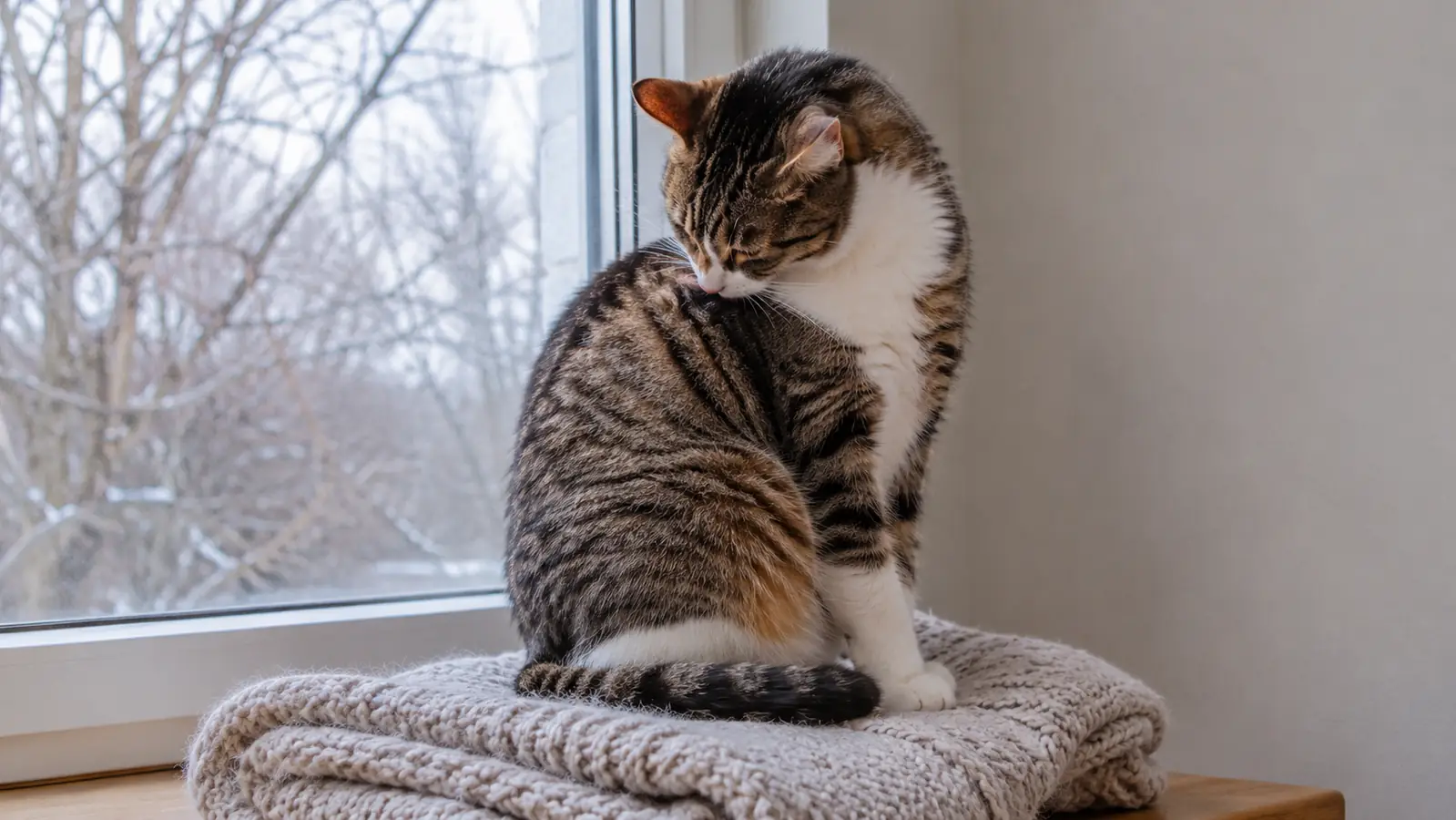
Every November, Pepper's coat changes. She is a nine-year-old gray domestic shorthair, indoor only, about eleven pounds, and for ten months of the year she is sleek as a seal. Then the heat comes on, the air in this house gets dry as a cracker, and her back starts to look like a sweater that has been through the wash one time too many. By January I can work my fingers into her undercoat and come out with a pinch of flakes. She also brings up more hairballs in winter, which I suspect is less about the cold and more about how much dead coat she is grooming off herself.
I spent nineteen years behind the front desk of a small animal clinic before I retired, so I know exactly what our vet would say first: rule out the medical things before you buy anything. Fair. But once the bloodwork comes back ordinary and the cat is eating and using the box, a dull winter coat is usually a fat problem. Not enough of the right kind of fat in the diet, and not enough brushing. Nutramax Laboratories makes the omega 3 I have used on Pepper for the last four winters, and the routine below is the one I actually follow, in the order I actually follow it. Your vet should hear about it before you start, especially if your cat takes any medication.
Start With the Fish Oil, Not the Fancy Brush
Welactin is a liquid omega 3 for cats with EPA and DHA on the label and a measuring scoop in the box, so you are not eyeballing a dose. This is the first change I would make, before anything with a comb or a shampoo bottle on it.
Amazon Check Today's Price on Amazon →Step 1: Rule Out the Boring Causes Before You Buy Anything
The boring causes are boring because they are common. A thyroid problem will flatten a coat and thin it at the same time. Dental pain stops a cat from grooming properly, and you see it first along the back and hindquarters, where she cannot reach without a working jaw. Stiff hips do the same thing in older cats who have quit bending around. So will a flea burden you never noticed, or a cat who has crept up two pounds and can no longer reach her own lower back. Any of those will beat a supplement every time.
Pepper gets her annual exam in October, which is deliberate. I want a baseline before the dry air arrives. Our vet runs bloodwork, weighs her, and looks at her teeth. Two years ago the weight had crept up and the vet pointed out that an eleven pound cat who cannot reach her own spine is going to have a dull coat no matter what I pour on her food. That was a useful and thoroughly unglamorous lesson.
You can do the cheap part yourself in about five minutes. Run your hand against the grain from tail to shoulders and look at what comes up. Part the fur along the spine and look at the skin underneath. If you see scabs, redness, specks that move, or a cat who flinches away, stop and call the vet. If you see dry flakes, a rough feel, and a slightly greasy base to the coat, that is the ordinary winter version, and it responds to the steps below.
Step 2: Read the Label and Match the Dose to the Cat
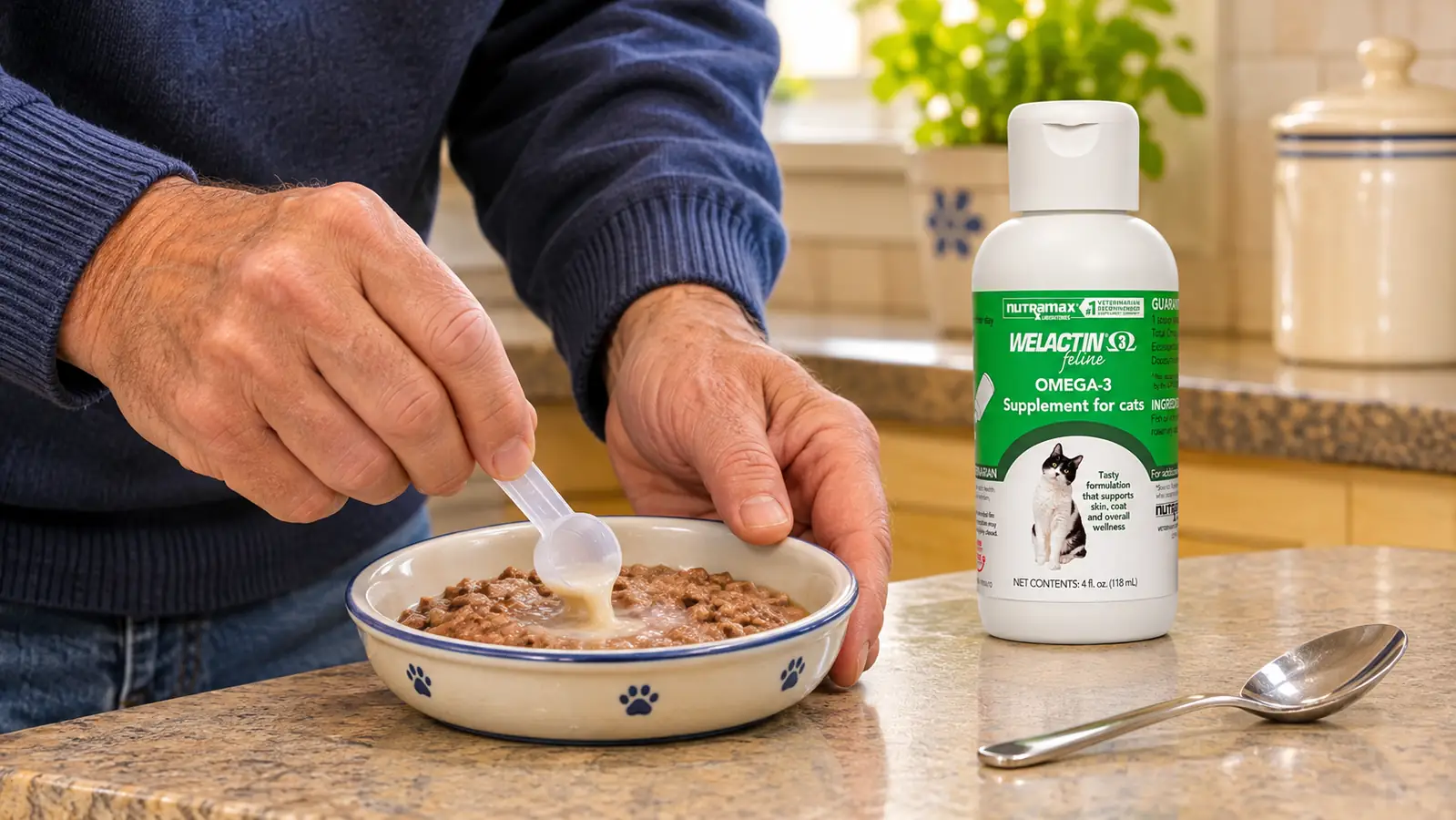
Fish oil is not one thing. What matters is EPA and DHA and how much of each is in a serving. Welactin lists both as active ingredients and comes as a liquid with a scoop, which matters more than it sounds. Capsules are fine for a cat who will swallow one. Pepper will not. She will eat around anything with a firm edge and then sit by the bowl looking betrayed for the rest of the evening. A liquid that disappears into a spoonful of wet food is the difference between a supplement that gets used and one that sits in the cabinet until it expires.
The bottle is four ounces, so write the date on it when you open it. Follow the dose and the storage directions printed on that label, not the dose you half remember from a forum thread. If your cat is well above or well below the usual eleven or twelve pounds, ask the vet to confirm the amount, because a small cat and a large cat are not the same animal and the scoop does not know that.
One thing I would not do is buy the biggest bottle of human fish oil on the shelf and guess at a dose. Cats are small and the margin is narrower than people assume. Nutramax Laboratories makes this one for cats, with the scoop sized for the job and the labeling written for a feline patient. That is worth something when the patient weighs eleven pounds and cannot tell you she feels odd.
Step 3: Start at Half a Scoop and Watch the Box
Whatever the label says the full amount is, I start at half for the first week. Not because I distrust the product, but because a cat's gut has opinions and fish oil can loosen stool. The first winter I tried this, Pepper had soft stool on day two, I panicked, and I stopped. Our vet laughed at me, kindly, and told me to go slower instead of quitting. Half a scoop for a week, three quarters for a week, then the full amount. That took us from a mess to no trouble at all.
How you deliver it matters as much as how much you deliver. Pepper eats her wet food in one sitting, so I stir it in and stand there until the bowl is empty, because a cat who walks away leaves most of the oil behind. If your cat is a grazer, put it in the smallest portion she will finish and give the rest after. Do not stir it into a bowl of dry kibble and leave the room. The oil coats the kibble, the kibble goes stale, and then nobody eats anything.
Watch for the signals that tell you to back off. Vomiting, soft stool that does not firm up within a few days, a cat who suddenly refuses food she used to like, or a fishy smell on the breath that was not there before. And if your cat takes any medication at all, particularly for thyroid, kidneys, or blood clotting, call your vet before the first scoop rather than after.
Step 4: Brush the Dead Coat Out Instead of Washing It Off
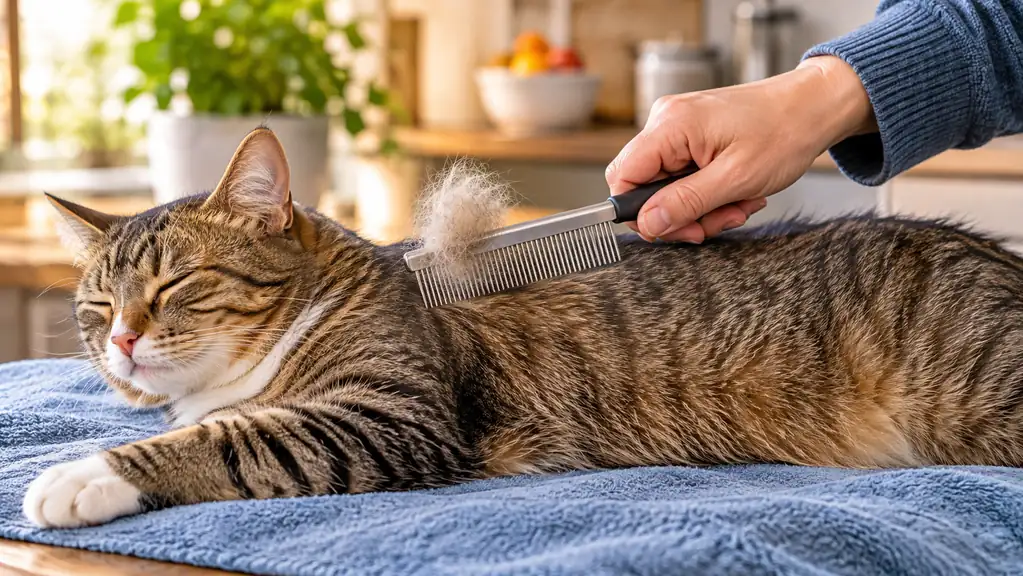
A supplement supports the hair that is growing. It does nothing for the hair already on the cat, and in winter a good deal of that hair is dead, sitting in the undercoat, holding flakes against the skin and blocking the air. Ten minutes with a fine-toothed comb twice a week does more visible good in the first month than anything you can put in a bowl. Pepper objects for about sixty seconds and then decides it is a spa treatment, which is standard cat logic.
I do not bathe her in winter. Bathing strips the oils the skin is working hard to make, and a cat who is already dry and flaky does not need that fight. If she gets into something, spot clean it and let the rest go. I keep the house around sixty-eight degrees and run a small humidifier in the room where she sleeps, and that has done more for the static and the flakes than I expected it to.
Pay attention to the back half. That is where a stiff older cat stops reaching, and it is where the mats begin. If you find a mat you cannot work out gently with your fingers and a comb, do not reach for kitchen scissors. Cat skin is thin and it moves, and I have seen more than one home grooming accident come through the clinic door on a Sunday.
Step 5: Give It Eight Weeks and Write Down What You See
Hair is dead tissue. The coat you are looking at in February was already forming under the skin in December, so no supplement turns a cat glossy in a week. I mark the calendar eight weeks out and take three photos on day one: standing, from above, and a close shot of the back. Then I do not look at them again until the eight weeks are up. Memory is a terrible measuring device, and I have talked myself into results and out of them more than once.
What I actually track is small and unromantic. Hairballs per week, marked on the calendar. Whether the flakes on the back are a pinch or a dusting. Whether the coat feels rough or smooth when I run a hand the wrong way up her spine. Whether she is grooming her lower back at all. Four things, written on the same page every Sunday, will tell you something true.
At eight weeks, some cats look better and some look the same. Welactin, the omega 3 from Nutramax Laboratories, holds a 4.2 star average across more than eighteen hundred ratings, which tells you most people see something and a real minority do not. If your cat is in that second group after a full eight weeks at the correct amount, the honest answer is that you tried it properly and it did not work for this cat. That is information, not failure, and it is what the next section is about.
Six weeks in, the flakes along Pepper's back were gone and the hair over her spine stopped feeling like a straw broom. Her hairballs went from two a week to one every ten days. That was the whole change, and it was enough.
What Else Helps
Water first. A cat on dry food only is a mildly dehydrated cat, and dry skin is the first place that shows. Pepper gets a spoonful of wet food with a little warm water stirred through it twice a day, which is less about nutrition and more about getting fluid into an animal who does not drink from a bowl the way a dog does. If your cat will not touch wet food, a running fountain helps some cats and does nothing for others, so watch the litter box rather than the bowl.
Weight and warmth come next. An overweight cat cannot groom her own back, and an older cat who is stiff will stop trying. A heated bed in the drafty room she favors, a box with a low side, a step up to the couch. None of that is a coat treatment, but it lets the cat do the grooming that keeps a coat healthy in the first place.
And keep the vet in the loop at the recheck, not just at the start. If eight weeks of a proper omega 3 and steady brushing has changed nothing, that fact is worth a phone call. It can point toward thyroid, kidneys, or a skin issue that needs a scrape rather than a supplement. The point of a simple at-home fix is not to avoid the vet. It is to handle the ordinary cases so the vet can spend her time on the ones that are not ordinary.
Eight Weeks From Now, You Will Know
A four ounce bottle of the Nutramax Laboratories omega 3, a scoop, and a calendar page with four columns on it. That is the whole protocol, and none of it is complicated. Ask your vet first if your cat takes medication, then give it a fair eight weeks before you judge it.
Amazon Check Today's Price on Amazon →