
Nineteen years behind a clinic front desk taught me something about supplements that never makes it onto a label. The ones that actually help are boring. Nobody drives across town for them. Nobody brings them up at the dog park. They just get reordered, quietly, month after month, by the same people. Purina Pro Plan Veterinary Diets FortiFlora is that kind of product. I handed boxes of it across that counter for the better part of two decades, usually to somebody whose dog had stopped producing solid stools and who had already tried switching foods twice. So when Biscuit's gut went sideways last spring, I did not go looking for something new and improved. I went looking for the box I already knew.
What follows is not a celebration of the brand and it is not a takedown either. It is what I actually watched happen over about three months of using Pro Plan Veterinary Diets FortiFlora on and off, what I paid attention to, and the parts of the experience that the glowing reviews tend to leave out. The short version: the sachets did one job well, and a second job that people keep crediting them for, they did not do at all.
The Quick Verdict
It firmed up Biscuit's stools by about the fourth morning and did nothing whatsoever for his stiff back end. If loose stools are your problem, this is a reasonable first box. If you are hoping for anything else, keep your money and call your vet.
Amazon Check Today's Price →The box I reordered twice before I sat down to write this
Thirty sachets. One a day. A powder that vanishes into a spoonful of wet food and a dog who never once turned his nose up at it. Same box that lived behind the clinic counter for nineteen years.
Amazon Check Today's Price on Amazon →How I've Used It
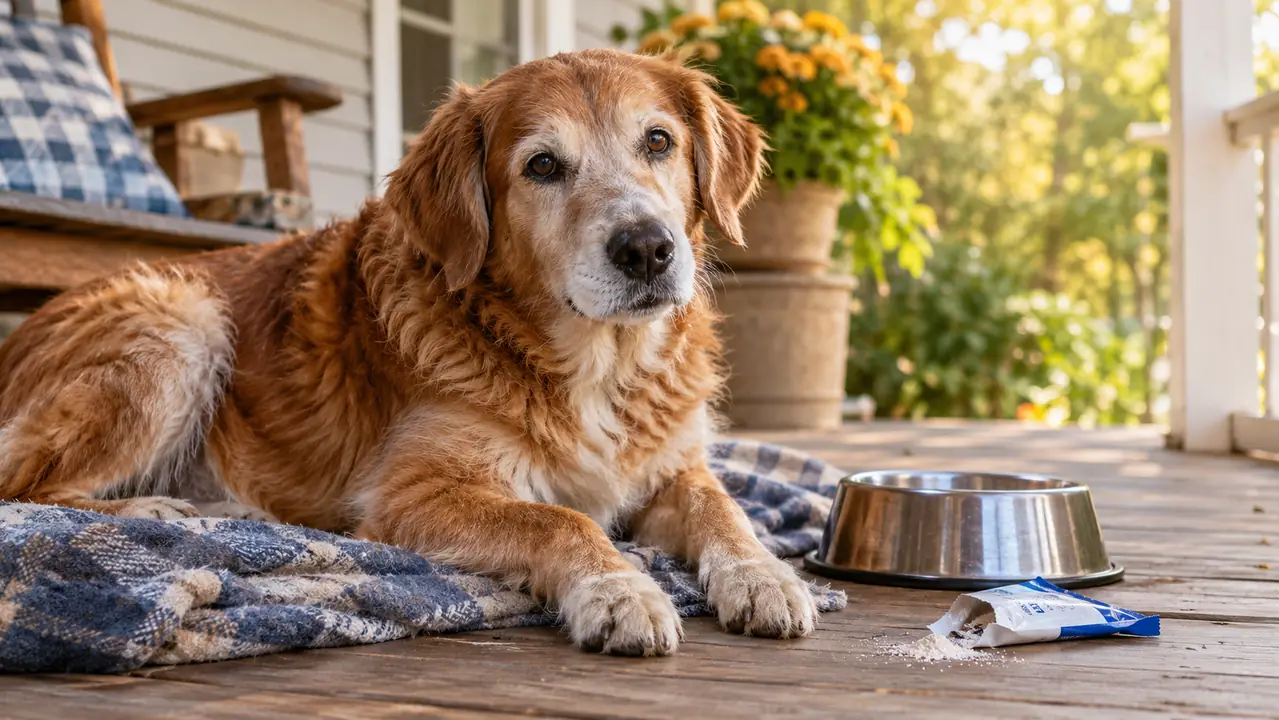
Biscuit is an 11-year-old beagle mix, about 28 pounds, and he has been with us since he was three. His stomach has never been negotiable. Change his food and you will know about it within a day. Last April Dale came home with a different bag of kibble because the store was out of the usual, and by Thursday the backyard told the story. Loose, pale, four trips outside before lunch, and a dog who wanted to go out again at two in the morning.
Our vet was not alarmed. She put him on a bland diet for a few days and then said the phrase I have heard a thousand times from the other side of that desk: give his gut some help while it settles. Then she named FortiFlora. Not a fancier brand, not the newest thing on the shelf. The one that was already there when I started at that clinic nineteen years ago.
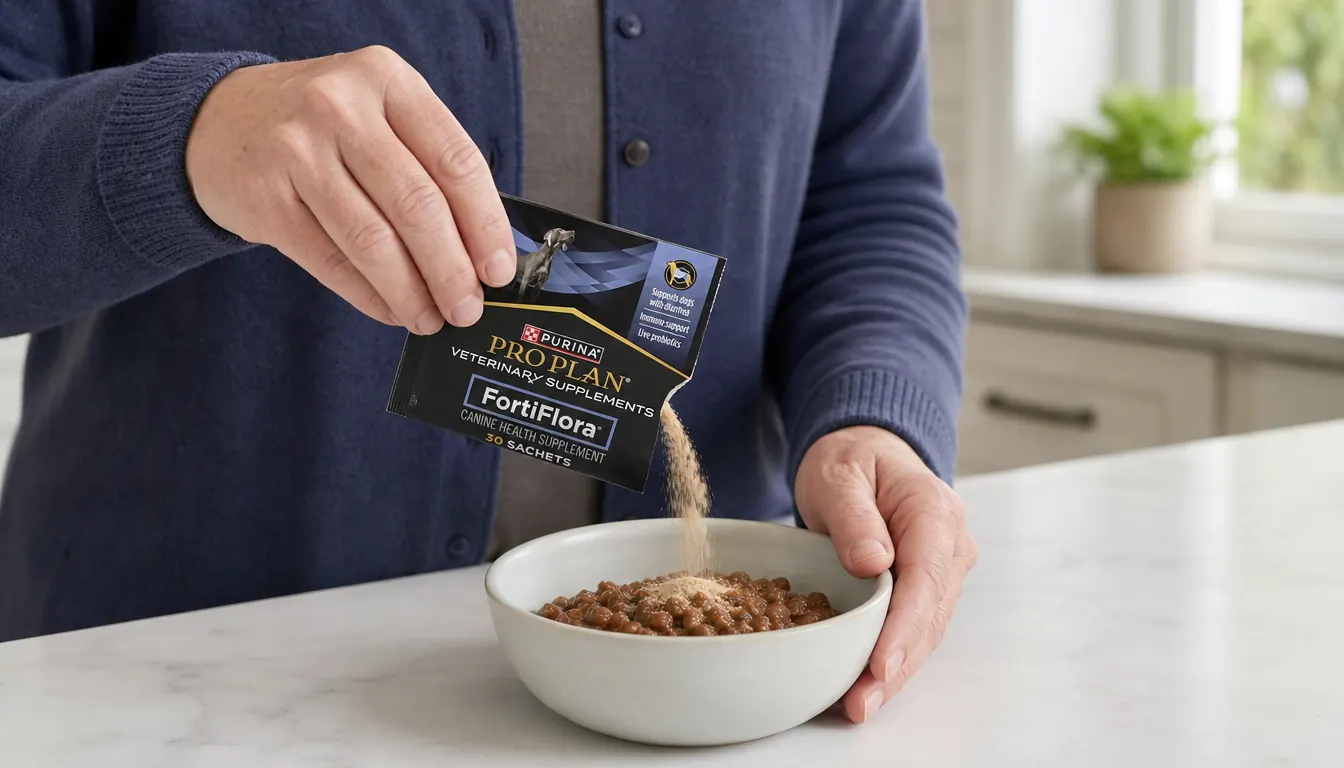
I bought the 30-count box that afternoon, the same Pro Plan Veterinary Diets box I had handed across that counter hundreds of times, and for the first time I read the back of it in my own kitchen with my reading glasses on. One sachet a day, torn open and stirred into a spoonful of wet food, morning, before his regular breakfast. He never refused it, not once in sixty sachets across two boxes. The first run went from a Tuesday in April to a Thursday in May, thirty days on the dot. Then I took three weeks off to see what happened without it, which was nothing, because by then his gut had settled and his old kibble was back in the bin where it belonged. The second run started on June the eighth, after a smaller upset I traced to a bag of training treats Dale had been handing out like a man with a mission. That is the whole of my testing. One dog, two boxes, a spiral notebook with dates down the left margin, and a husband who thinks I am ridiculous. It is not a clinical trial and I will not pretend otherwise.
What Is Actually in the Sachet
The active ingredient takes one line. Enterococcus faecium SF68 at 1x10^8 CFU. That is a single strain of bacteria at a stated count. The rest of the sachet is liver flavor and yeast. No blend of twelve things, no pumpkin, no clay, no long list you need a veterinary degree to sound out. If you have been reading probiotic labels until your eyes cross, the shortness of this one comes as a relief.
The listing calls it the number one vet-recommended probiotic brand, based on a survey of US veterinarians who named a brand. I have no reason to doubt that, and I also want to be straight about what it means. A clinic recommends what it has seen work and what it can explain to a worried person in ninety seconds at the counter. That is a real signal. It is not the same thing as a study run on your particular dog with your particular problem.
On the label this is a product for the dietary management of puppies and adult dogs with diarrhea, and the listing also mentions antioxidants in support of the immune system. It is a supplement, not a medicine. It will not do a thing for a dog who has eaten a chicken bone or a dog running a fever. The box itself is 3 by 2.25 by 3.25 inches and holds 30 sachets, 1.06 ounces total, so it takes up less counter space than a coffee mug and fits in a kitchen drawer without a fight.
By the fourth morning the stool was solid enough to pick up with a bag. That was the entire result, and it was the result I bought.
What the Sachets Actually Did
Here is the honest part, and the reason a box still lives in my cupboard. The first sachet went into his breakfast on a Tuesday morning. Wednesday was no better. Thursday was worse, if anything, and I stood out in the yard at six in the morning with a bag on my hand telling myself I had wasted a week and a good box. Friday the stool came up in one piece, which sounds like a strange thing to be glad about until you have spent four days scraping a lawn. By Saturday it was solid enough to pick up with a bag instead of a shovel. Not perfect. Solid. By the end of that first week he was back to two trips outside a day and sleeping through the night, which meant Dale and I were sleeping through the night.
His appetite came back with it. A dog with a sore gut eats like a dog with a sore gut, head down and unimpressed, and once the stools firmed up he was standing at the bowl again with his ears up and his tail going. He cleaned the bowl in under a minute both mornings that weekend, which for any dog is a good sign and for one with a sour stomach is a very good one. I do not think the powder did that directly. I think the gut settled, and everything downstream of the gut settled with it. That is not a smaller thing. For a week there, it was the only thing.
The part I cannot prove: I switched him back to his usual kibble on day two. So his recovery was the bland diet, the old food and the sachet all working at once. Anyone who tells you they isolated the probiotic in a situation like that is guessing. What I can tell you is that the second time, in June, I gave the sachet alone after a smaller upset, without touching his food, and the stools firmed up in three days. Two data points and one dog. That is all I have, and it is more than most reviews give you.
What It Did Not Do
It did not touch his hips. Biscuit has been stiff in the back end on cold mornings for a couple of years, and I had a small foolish hope that a healthier gut would somehow show up in his joints. It did not. Six weeks in, he was still slow down the porch steps at dawn and still needed the ramp into the truck. If you are shopping for a mobility problem, you are shopping for the wrong product.
His coat looked the same. I had half expected a shine by week six, the way the enthusiastic reviews talk, and there was none. His gas was maybe slightly less, or maybe I had simply stopped noticing. The thunderstorms in July went no differently at all. There was one on a Wednesday evening that had him under the desk before the second roll of thunder, panting, pacing, nails ticking on the hardwood, and the sachet in his breakfast did nothing whatsoever about it. Dale sat on the floor beside him for the better part of an hour the way he always does, one hand flat on his side. Anyone claiming a probiotic calmed their dog's storm panic is describing a good month, not a mechanism. I have watched a great many thunderstorm seasons through that front window and thunder is thunder.
A word about the reviews that bother me. Somewhere in that pile are people saying this fixed their dog's allergies, their dog's itchy ears, their dog's bad attitude. I am not calling anyone a liar. I am saying dogs get better for reasons nobody writes down, and a supplement that happened to be in the bowl during a good week gets the credit. Read those the way you would read a restaurant review from somebody who was there for a birthday.
What I Liked
- One clearly named strain at a stated count, so you know exactly what you are giving
- Powder disappears into a spoonful of wet food, even for a fussy dog
- Stools firmed up by day three or four in our house, twice
- Single-serve sachets mean no scooping, no shaking, no half measures
- Short ingredient list you can read out loud to your vet over the phone
Where It Falls Short
- No help at all for stiffness, coat or nerves, whatever the reviews claim
- One size only, so you cannot adjust the dose up or down
- Clumps badly on dry kibble unless you add a splash of water
- Costs more per day than a can of plain pumpkin
- Thirty sachets is thirty days, so it becomes a reorder you have to remember
The Cat Question, and Why Pepper Never Got Any
Pepper is nine, gray, indoor only, and picky in the way that only a cat can be picky. She has hairballs in spring and a dull coat every winter. I asked our vet whether I could split a dog sachet between the two of them and she said no, that there are feline formulas for exactly this reason, and that the dog product is labeled and dosed for dogs. I did not argue. I have seen what happens when somebody splits a tablet meant for a forty-pound dog and gives it to a nine-pound cat, and it is a phone call at ten at night.
So Pepper got nothing, and I want to be upfront that this review covers dogs only. If your question is about a cat, ask your vet which product and which amount. Do not let a blog post, mine included, make that call for you.
The Small Annoyances Nobody Mentions
The sachets are both the good part and the bad part. Good, because there is no scooping and no guessing whether you got a half teaspoon or a full one. Bad, because there is no adjusting either. A big dog and a small dog get the same sachet. Our vet was fine with that for Biscuit at 28 pounds. Yours may not be, especially with a puppy, and that is a question worth asking before you open the box.
The powder is fine and pale and it does not dissolve. Stir it into a spoonful of wet food and it vanishes. Sprinkle it dry over kibble and you get little clumps stuck to the bottom of the bowl that the dog licks around and leaves. A splash of warm water fixes it. It took me a week to work that out, which tells you something about me and nothing about the product.
Storage is simple. Keep the box dry, keep it out of the sun, and it will outlast the thirty days easily, because the sachets are sealed foil and the powder does not care about humidity the way a tub of soft chews does. Mine lives in the drawer beside the stove, behind the can opener, which is exactly why I forget it. The box is small enough to hide, and that sounds like a good thing right up until the fourth week. Thirty sachets is thirty days, and if you are built like me you notice the box is empty on a Saturday morning when the dog is already circling the kitchen and the nearest store is twenty minutes of two-lane road away. I keep a spare in the pantry now and write the start date on the flap with a marker. That small bit of fuss has saved me two Saturdays.
Who This Is For
This makes sense for a dog with soft or loose stools, a dog coming off a food change, a puppy with a nervous gut, or a dog who has just finished a course of antibiotics and needs his gut repopulated. It makes sense if you want a single stated strain instead of a blend of eleven things you cannot pronounce. It makes the most sense if your own vet named it, which is the strongest reason on this page. And it makes sense as a thirty-day trial, because that is exactly how long a box lasts, so you get a clean beginning and a clean end to judge it by.
Who Should Skip It
Skip it if the problem is his hips, his coat, his ears or his nerves. Skip it if there is blood in the stool, if he is vomiting, if he is flat and lethargic or running a fever, because that is a same-day vet visit and no powder in the world fixes it. Skip it if you want to give half a dose, because you cannot. And skip it if the plan is to buy a box and never call your vet. A supplement that quietly covers a symptom for three weeks while something worse develops underneath is worse than no supplement at all.
One last thing, and I mean it kindly because I spent nineteen years saying it across a counter. Write down the date you started and what you were hoping would change. Three weeks from now you will not remember whether the stools got better on the second day or the ninth, and neither will your vet. A box, a pen and a calendar will tell you more than any review, including this one.
Thirty days, one sachet a day, one honest question for your vet
If loose stools are the thing you are trying to solve, this is a fair first box and a fair thirty-day test. Start it with your vet's blessing, note what changes and when, and give it the full month before you decide.
Amazon Check Today's Price on Amazon →