

Biscuit is eleven, about twenty-eight pounds, and a beagle mix we adopted when he was three. He is the reason I read every label twice. For most of a decade his stomach ran on a short fuse. Switch his kibble too fast and I would be up at two in the morning with a flashlight and a roll of paper towels. Give him one scrap of something new and the next day told the story.
I spent nineteen years as the front-desk manager at a small-animal clinic, so I had watched a lot of people walk out with a box of Purina Pro Plan Veterinary Diets FortiFlora tucked in with their prescriptions. I knew it was the probiotic the vets reached for first. What I did not know, until I started using it myself, was what months of daily use would actually look like on a dog I live with rather than a chart in a file cabinet. This is that account. Check with your own vet before you start any supplement, especially if your dog is on medication, because I am a retired front-desk manager and not a veterinarian.
The Quick Verdict
Biscuit's loose-stool days dropped from roughly four a week to about one, then to near zero, over six months. The powder is easy to hide in food. The catch is the price per dose for a large dog and the fact that it manages the symptom without fixing the underlying reason.
Amazon Check Today's Price →The probiotic our clinic's vets reached for first, and the one I ended up buying myself
Purina Pro Plan Veterinary Diets FortiFlora is a once-a-day powder with one documented strain, Enterococcus faecium SF68, plus liver flavor and yeast to make it go down easy. It comes in a 30-count box. Sprinkle it on top of the bowl and that is the whole routine.
Amazon Check Today's Price on Amazon →How I've Used It
I started FortiFlora on Biscuit in the late winter, the same week I switched his kibble because the store was out of his usual. That was not a clean experiment and I want to say so up front. In the clinic I used to watch for this exact problem: a client would change three things at once and then credit or blame whichever one they were most nervous about. I did it anyway, because a dog with a bad gut does not wait around for you to set up a controlled study. I opened the first packet on a Tuesday morning, February 18, on the back step, and sprinkled it over a half cup of the new kibble. I wrote the date on the box in marker. For the next two weeks I fed him at six and again at five, and I gave the powder only at the morning meal so I could watch the afternoon result.
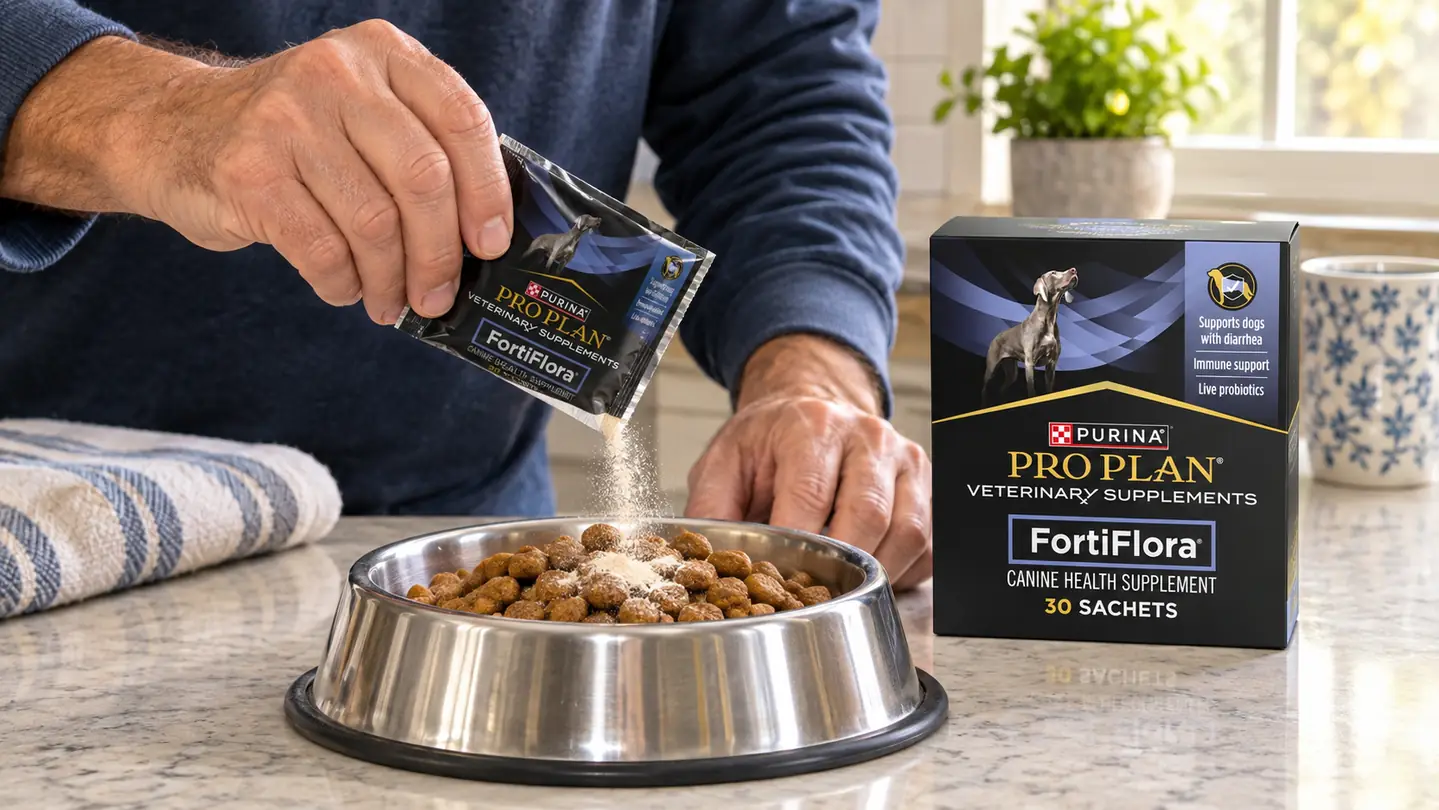
The box holds thirty packets. One packet a day, torn open and sprinkled over his morning meal. The powder is very fine and smells like liver, which matters more than it sounds like it should. Biscuit is a hound, so he eats like a shop vac, but I have met plenty of dogs who pick around supplements. He never once picked around this.
I gave it to him daily for six months. There were two interruptions, both because I ran out before the reorder arrived. The first gap ran about a week and I saw his stools loosen again by day four. That single observation did more to convince me than all the reading I had done. I now keep an unopened box in the pantry the way I used to keep a spare set of keys.
I also gave it to Pepper, our nine-year-old gray cat, for a short stretch in winter when her coat went dull and flaky. FortiFlora is labeled for dogs, and our vet was clear that she would rather see a cat on a dog product briefly than on nothing at all, but that conversation came first. If you have a cat, ask before you sprinkle. Do not take my word for it.
What Is Actually In the Packet
This is where I slow down, because the front desk taught me that most supplement confusion comes from people never being told what they bought. FortiFlora has one probiotic strain in it: Enterococcus faecium SF68, at a labeled level of 1x10^8 CFU. One strain. Not five, not twelve. Just that one, in a measured dose.
That sounds thin next to the multi-strain probiotic bottles you see at the pet store, and I understand why people pick up the bottle with twelve strains on the front. The argument for one strain is that a single documented strain at a real measured level is easier to verify than a dozen strains nobody has tested together. SF68 is one of the most studied strains in dogs. That is the reason it is in this box and not something newer.
The other ingredients are liver flavor and yeast. Liver flavor is the palatability engine. Yeast is there for the animal protein and B-vitamin content, and it also helps the powder taste like food instead of like a supplement. The listing also mentions antioxidants for immune support, which is the line the manufacturer prints. I would not buy the box for the antioxidant claim. I would buy it for the strain and the dose. I keep the box in a sealed container in the cabinet above the sink, away from the stove, because I ruined a box of powdered creamer once and learned what humidity does to fine powder. A packet that has clumped into a hard little brick will still dissolve in canned food, but it will not cling to kibble.
It is unflavored in the sense that it is not beef or chicken flavored, but a dog's nose will read liver. The powder is fine enough that it clings to kibble. If your dog gets canned food, stir it in. If your dog gets dry food, sprinkle and shake the bowl a little. That is the whole method.
What Changed Over Six Months
Here is the honest accounting. In the first month I did not see much. Biscuit's morning output was firmer maybe half the time. I kept a note on the kitchen calendar, one letter a day, because I had learned from years of client phone calls that memory is a liar about this kind of thing.
By the second month the pattern had shifted. Instead of four loose days in a week, we were down to two, then one. The change was not dramatic on any single morning. It was the absence of the bad mornings that I noticed, the way you notice a noise only after it stops.
I remember one Saturday in April, a family cookout over in Cleveland, Tennessee, where a cousin fed him a piece of a hot dog bun. In the old days that would have meant a two a.m. wake-up. That night he slept through and his next morning was normal. I am not going to claim the powder stopped a hot dog bun. I am telling you what the calendar said.
By month four we were at roughly one loose day every ten days or so, usually after he had gotten into something he should not have. By month six, most weeks passed with nothing to report. The chart on this page is my own calendar, translated. It is not a study and I will not pretend it is.
What did not change: his gas. Beagle owners will understand that I had hoped. FortiFlora did nothing for the gas. His coat did not change. His energy did not change. He is eleven with stiff hips on cold mornings and that stayed exactly the same, which is a separate matter and a separate conversation with your vet. This is a gut product, not a joint product and not a cure in a foil packet.
We went from four loose days a week to roughly one, then to most weeks with nothing to report. The change was not dramatic on any single morning. It was the absence of the bad mornings.
The Practical Annoyances
Cost per dose. Thirty packets in a box, one a day, so a box lasts a month for one dog. For a twenty-eight pound dog that is a real line item every month, and for someone with two large dogs it doubles. I understand why people look for a cheaper multi-strain alternative, and my advice is to look, but compare the CFU count and not just the strain count on the front.
The foil packets. They tear easily but they are small, and I have dropped more than one on the floor and had to decide how much I really meant it. A scissors-straight tear at the top corner works better than fingers. Keep the box somewhere dry, because powder in a humid pantry will clump.
It manages, it does not cure. If your dog's loose stools are caused by a food sensitivity, a parasite, or something structural, FortiFlora will make the symptom quieter while the cause sits there. That is not nothing, but it is not a diagnosis. This is why the first thing I would tell anyone is to get a stool sample checked before you buy a six-month supply of anything.
And the gap problem. Miss a few days and you can feel the difference in about four. The first real gap came in June. I ordered on a Thursday, assumed two days, and it took five. By day four his stools were soft again, and by day five they were what they had been in February. Five days. That is how fast the floor drops out. That is the whole reason I now keep a spare box. If you travel or you are the kind of person who forgets a daily anything, set a phone reminder. I did.
What I Liked
- One documented strain, Enterococcus faecium SF68, at a real measured level of 1x10^8 CFU
- Liver flavor means most dogs eat it without a fight
- Fine powder clings to kibble instead of sinking to the bottom of the bowl
- The strain vets reach for first, which is why I recognized the box from the clinic
- Noticeable difference in stool consistency within the first month for Biscuit
Where It Falls Short
- One box lasts one month for one dog, so this is a permanent monthly cost
- Problems return within days when you stop, so it manages rather than fixes
- No effect at all on gas or on his stiff hips
- Small foil packets are easy to spill and need to stay dry
- Labeled for dogs, so cat use needs a vet conversation first

How It Compares to a Multi-Strain Probiotic
The question I got most at the front desk was whether the twelve-strain bottle was a better buy than the little box the vet handed over. My answer then is my answer now: it depends on whether you want a documented dose of one thing or an untested blend of many things. Pro Plan Veterinary Diets FortiFlora is the first kind. That is not inherently better, and there are dogs who do fine on a blend of a dozen strains at a fraction of the cost.
What I would say is that if your dog has had a rough few weeks and you want to intervene with the thing most likely to be recommended by a vet, start here and see if the calendar changes. If you want to keep a dog on something long-term for general gut support and cost matters, that is a fair time to look at a multi-strain product. I go through the differences in more detail in my comparison of FortiFlora against Proviable if you want the side-by-side.
If what you are really chasing is the broader question of why a probiotic helps a sensitive stomach in the first place, that is a different read and I would start there before spending money. Biscuit has been on it since February and I have no plan to change that while it is working.
Who This Is For
A dog with a sensitive stomach whose loose stools come and go with food changes, stress, or a course of antibiotics. A dog who has been through the obvious checks, stool sample and food trial, and whose vet has shrugged and said the gut is just irritable. A picky eater who turns his nose up at capsules but will take a liver-flavored powder. Someone who wants to hold one box and one dose in their hand instead of decoding a label with eleven ingredients they cannot pronounce.
It also fits the person who has already spent money on the cheap version and watched it do nothing. I have been in that line at the register and I would rather pay for the thing that works than keep gambling on the thing that does not.
Who Should Skip It
If your dog has never had a stool sample checked, skip this and go do that first. Loose stools in an older dog can be a lot of things, and a supplement that quiets the symptom while a problem grows is the wrong first move. If your dog has gas as the main complaint, this will disappoint you. If you are not willing to run it daily for at least three or four weeks before judging it, save your money, because the changes come slowly and a three-day trial tells you nothing.
And if the cost is going to be a strain every month, be honest with yourself about that before you start, because stopping and starting is the one pattern that makes this product look like it does not work. It works. You just have to keep the box stocked. Also skip it, or ask first, if you are buying it for a cat or a dog on immune-suppressing medication. That is a question for your vet and not for a retired front-desk manager with a strong opinion.
One box, thirty packets, one packet a day. That is the routine that worked.
Purina Pro Plan Veterinary Diets FortiFlora is the probiotic I now keep a spare box of in the pantry, because five days without it is all it takes to remember what we came from. Talk to your vet first, then look at today's price.
Amazon Check Today's Price on Amazon →