

The first thing I want to say about Cosequin is that it did not turn Biscuit back into a puppy, and any review that tells you a supplement will do that is selling you something other than the truth. What it did do is narrower and more useful than that, and it took me about four months of keeping an actual written record to separate the changes I could point to from the changes I wanted to see. This is that record, laid out plainly, including the parts where I was wrong.
A little context on us. I spent nineteen years as the front-desk manager at a small-animal clinic before I retired, which means I have handed out more joint chews than most people will ever see in a lifetime and I have heard every version of "it worked wonders" and "it did nothing." Biscuit is our eleven-year-old beagle mix, twenty-eight pounds, rescued at three, stiff in the back hips on cold mornings. He is also the dog who gets an upset stomach if I change his food too fast, so I was not casual about adding Nutramax Laboratories to his routine.
The Quick Verdict
A legitimate, well-documented joint supplement with a real ingredient list and a chew that most dogs will take. It helped Biscuit's cold-morning stiffness in a way I could measure. It did not fix his reluctance to jump into the truck, and it is not cheap per chew. Check with your vet first, especially if your dog is on other medication.
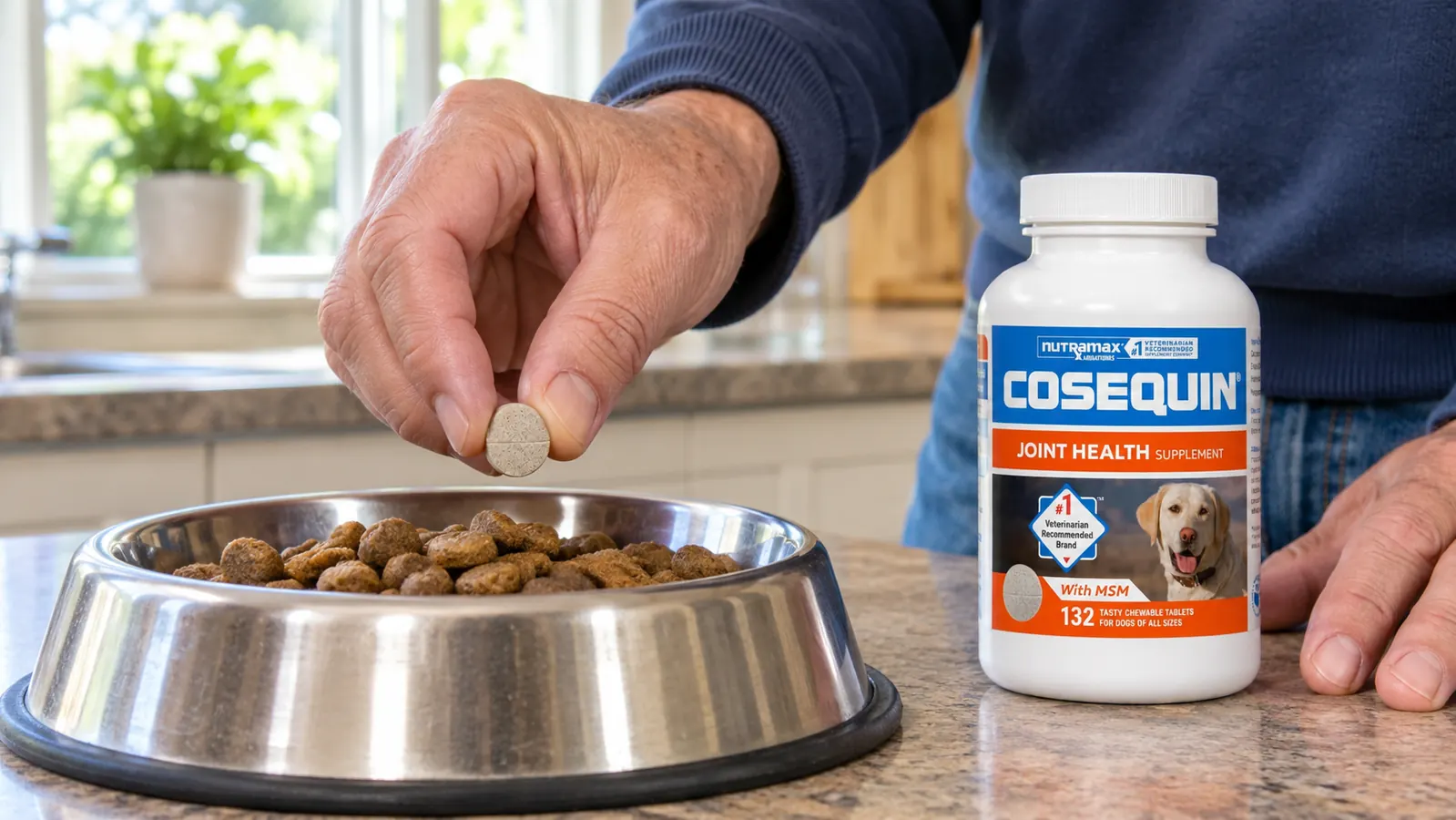
Amazon Check Today's Price →Here is the exact bottle I put on Biscuit's shelf, 132 chewable tablets
Enough for a two-month run at his weight, so you actually find out whether it works instead of guessing from a ten-day sample. Confirm the dose with your vet before the first chew.
Amazon Check Today's Price on Amazon →What Nobody Tells You Before You Open the Bottle
The label conversation should come before the results conversation, because most of the disappointment I saw at the clinic started here. The bottle lists glucosamine hydrochloride, methylsulfonylmethane, and sodium chondroitin sulfate as the active ingredients, along with the company's own identifiers for two of them, FCHG49 and TRH122. Those codes are not marketing decoration. They are Nutramax Laboratories' way of saying this is a specific, tested form of the ingredient rather than whatever the cheapest supplier shipped that month, and after years of watching generics come and go, I have come to care about that distinction more than I used to.
Nutramax Laboratories has been in pet health for over 25 years by their own accounting, and I will tell you what that actually means to a person standing in a kitchen with a checkbook. It means the label is unlikely to change out from under you between bottles. I have watched people find a product that finally helped their dog and then discover, eight months later, that the formula was quietly reformulated and their dog was back at square one. Consistency is not a glamorous selling point. It is the whole ballgame with a maintenance product.
What nobody says out loud is that glucosamine is not a painkiller. It is not going to work like the medication your vet prescribes for a flare-up, and if you are expecting that, you will be disappointed by day four and quit. It is closer to a maintenance product. You are feeding the raw material the body uses in cartilage, and you are doing it consistently, over months, while also doing the other things that matter. If your dog is in obvious pain right now, call your vet. Do not start a chew and hope.
The other thing that never makes the label is the arithmetic. Biscuit is twenty-eight pounds, which put him in a middle dosing bracket, and the chewable tablets go fast at his rate. The 132-count bottle lasted us about two months. That is the number that matters when you compare this to a cheaper tub of soft chews, because a cheaper tub that your dog refuses is infinitely more expensive than the one he eats.
Glucosamine is not a painkiller. It is closer to a maintenance product, and you are doing it over months, not days.
How I Actually Ran This, Because Otherwise the Results Mean Nothing
I gave Biscuit the chewable tablets with his evening meal, every night, and I did not miss a night for six months. That sounds like bragging. It is closer to a confession, because the reason I was so strict is that I had already half-tried a joint chew two winters earlier and quietly stopped when the bottle got low and I was not sure it was doing anything. You cannot evaluate something you take sporadically. I learned that the expensive way.
The record was a spiral notebook on the kitchen counter, and it took about ten seconds a night. I wrote the date, whether he took the chew without a fight, and a single number from one to five for how he moved that morning, before I had spoken to him or coaxed him off his bed. That last part matters more than it sounds. If you rate the dog after you have already watched him trot to the door for a walk, you are rating his enthusiasm, not his stiffness.
I also wrote down the things I could count instead of feel. How many attempts it took him to get up off the rug. Whether he used the little carpet runner I put down on the hardwood, which he had been avoiding. Whether he got into the truck on his own or waited to be lifted. Numbers and yes-or-nos, not impressions. My memory is generous and it flatters whatever I have already decided, and I know that about myself.
One thing I did not do, and I want to be honest about it, is run a clean test. I did not have a placebo period. I did not stop the chew for a month to see whether he got worse again. I could not bring myself to do it once I thought he was improving, and that is a real limitation on everything below. What I have is a before and after with a lot of other things changing at the same time, and I will flag those as we go.
What Changed, Month by Month
The first three weeks, nothing. I want that in writing because the internet is full of people who report a difference in five days, and either their dog was never that stiff or they were watching for a change so hard they found one. Biscuit was the same dog in week three that he was in week one. I kept going because our vet had already told me the timeline was closer to eight to twelve weeks, and because I had promised myself a full bottle before I formed an opinion.
Somewhere in the fifth and sixth week, the morning number started coming down. Not dramatically. He went from a three most mornings to a two and a half, then more twos than threes. The translation, in real terms, is that he stopped doing that hitch at the top of the stairs and started taking them in one continuous motion. If you have an older dog, you know the hitch I mean. It is small and it is the first thing I noticed, and I noticed it because I had written down the number instead of trusting my gut.
By month three, the change that mattered most to me was not on the hardwood at all. It was the truck. Biscuit had stopped putting his front paws up on the tailgate and waiting, which is a polite way of saying he had stopped trying. Around week eleven or twelve he tried it again, once, badly, and then again the next day and made it. He still needs the ramp I bought that winter. But he tries now, and the trying is not nothing. A dog who has stopped attempting something has usually stopped for a reason.
The last thing, and it surprised me. His coat looked better. Not glossy-show-dog better, just less dull than it had been through the previous winter. I cannot prove the chew did that and I am not going to pretend I can, since I also changed nothing else and I am told MSM can have that effect. But I wrote it in the notebook because it was true, and I have seen enough clinic dogs on joint supplements to know it is a thing people mention.
What Did Not Change, and This Is the Longer List
His willingness to get in the car for a vet visit did not change at all. This is the one I want every reader to hear clearly, because it is where supplements get oversold. Biscuit still plants his feet and still needs to be lifted into the back seat, and he still pants the whole way there. That is anxiety, not arthritis. There is a joint product in the world that fixes a nervous dog in a car and it is not this one, and no chew on the market is going to touch it.
The other front-leg thing did not change either. He has a habit of holding one front paw up for a second when he first stands, which our vet has looked at and is not concerned about, and the chew made zero difference to it. Six months, no change. I mention it because it taught me something about reading reviews. If I had only been watching for improvements, I would have quietly stopped counting that one and then told you the product fixed everything, and I would have been wrong without lying.
Thunderstorms got worse, if anything, which has nothing to do with joints but everything to do with the fact that a supplement is not a whole-dog solution. His weight did not change, his appetite did not change, and his breath did not improve, which I had not expected it to but which I feel obliged to report since I have now reported everything else.

The Chew Itself, and the Stomach Question
Biscuit is the dog who gets loose stools from a food change, so I braced for trouble. I introduced the chew at the labeled dose straight away rather than tapering, because the tablet is not a food and there is nothing to transition. He had no stomach upset at all across six months, which I will credit to the formulation and also to the fact that I gave it with a full meal rather than on an empty stomach, which is what I would tell anyone at the front desk.
He eats them. That sounds like a low bar until you have stood in a kitchen with a dog who has decided a particular soft chew tastes like medicine and cannot be persuaded otherwise. The chewable tablet is not a treat he begs for, but he takes it from my hand and chews it, and I have never once had to hide it in peanut butter. For a picky dog this is genuinely the deciding factor between a supplement that gets used and one that sits in a cabinet, and it is the reason I stopped shopping around after the first bottle of Nutramax rather than cycling through three brands the way I did with his food.
The bottle is not a soft chew, and the tablet does tend to crumble at the end. I have gotten into the habit of holding my hand under his chin. That is a small annoyance and I am telling you about it so you are not surprised, not because it should stop you.
What I Liked
- Specific, tested forms of glucosamine and chondroitin, not an anonymous blend
- Chewable tablet that a picky dog will take without hiding it in food
- No stomach upset at all across six months on a dog with a sensitive gut
- 132-count bottle gives a real two-month trial at a medium dog's dose
- Very large review base, so you are not relying on my one dog
Where It Falls Short
- Roughly a two-month supply per bottle at a medium dog's dose, so cost per month is not small
- Takes eight to twelve weeks before you can judge anything, which most people do not wait out
- Did nothing for car anxiety or the front-paw habit, and I want you to know that going in
- Tablets crumble near the bottom of the bottle
- Requires a vet conversation first if your dog is on other medication
Who This Is For
This is for the owner of a middle-aged or older dog who has started showing the small stuff. The hitch on the stairs. The slower first five minutes of a walk. The reluctance to get up off a good rug. If you are at that stage, where nothing is emergencies and everything is just slightly harder than it used to be, this is the window where a maintenance product makes sense to try, and where you can still measure a difference because the baseline is not too far gone.
It is also for the person who will actually finish the bottle. If you are the kind of person who starts a supplement in November and finds it half-full in March, do not spend the money. I am not being unkind, I am being the person who did exactly that once. A joint supplement taken three nights a week is a joint supplement you cannot evaluate.
And it is for the person who wants the boring, documented version of the ingredient rather than the cheapest per-ounce tub on the shelf. Nutramax Laboratories has been doing this for a long time and their label tells you which specific forms they use. If that sounds like it should not matter, ask yourself why the cheap brands never print a code next to their glucosamine.
Who Should Skip It
If your dog is lame, yelping, or refusing to bear weight, skip this and go to your vet. A supplement is not the answer to acute pain and you will waste two months finding that out. Same if your dog is already on a prescription anti-inflammatory or any other medication, because interactions and dosing are a conversation with your vet, not a review on the internet. I say that as someone who spent nineteen years booking those appointments.
Skip it if you want a fast answer. Eight to twelve weeks is the honest window, and if you cannot commit to that, you are buying an expensive lesson. Skip it too if your dog is a serious chewer who destroys soft chews, since the tablet form may not suit, and skip it if the monthly cost is a genuine strain, because there are cheaper products with decent glucosamine that are a reasonable compromise. I would rather you bought a modest product you can afford to keep giving than a good one you stop in three weeks.
One last honest note. If you are expecting this to be the thing that lets your old dog run like he did at five, no product is that, and I would be doing you a disservice to let you think otherwise. What it bought us was a dog who takes the stairs in one motion and tries the truck again. That is a modest, real improvement, and after six months of counting, I will take it.
Before you start anything, call your vet. Tell them the dose on the label, tell them what else your dog takes, and ask whether the timing is right. That phone call costs nothing and it is the one step I would never skip.
Six months of counting chews, one bottle at a time. Here is where I'd start
Grab the 132-count so you get a real trial rather than a sample, and confirm the dose for your dog's weight with your vet first. If Biscuit's notebook is any guide, you will know something real by week ten.
Amazon Check Today's Price on Amazon →