
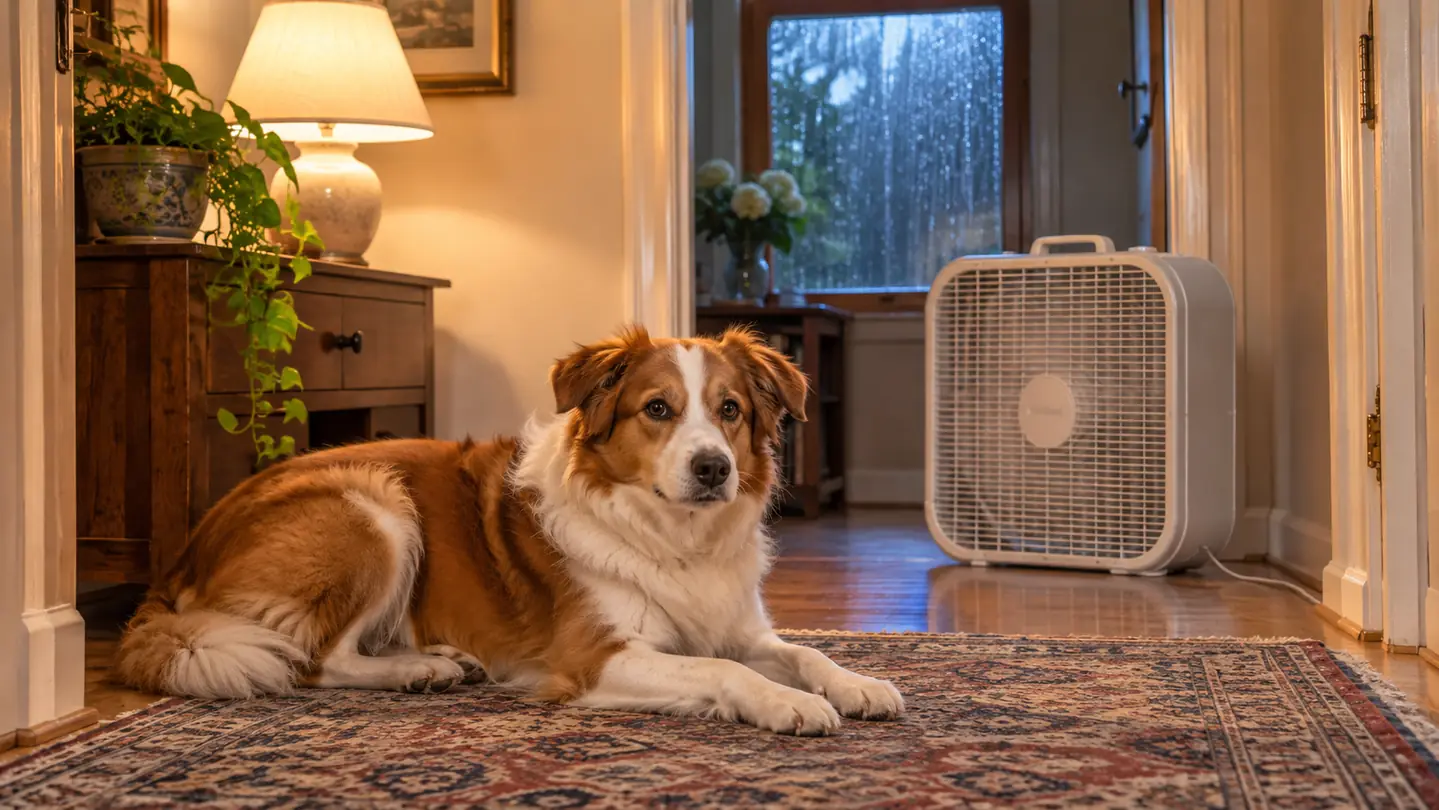
Biscuit hears the thunder before I do. He is an 11-year-old beagle mix, about 28 pounds, and somewhere around the third low rumble he is up off the rug, pacing the hallway, panting, and trying to fold himself into the six inches of space behind the recliner. I spent 19 years behind the front desk of a small-animal clinic, so I know the phone call that follows. A worried owner, a storm on the radar, and a dog who has already decided the world is ending.
Here is what I do now, and what I tell friends who ask. I keep VETRISCIENCE Composure chews in the cabinet above the microwave. I give one roughly 30 minutes before the radar turns ugly. Then I do four other things that have nothing to do with the chew. The chew is not a light switch. It is one part of an hour. And if your dog takes medication or has a health problem, the first call is your own vet, not me and not a product page.
The chew I reach for before the radar turns ugly
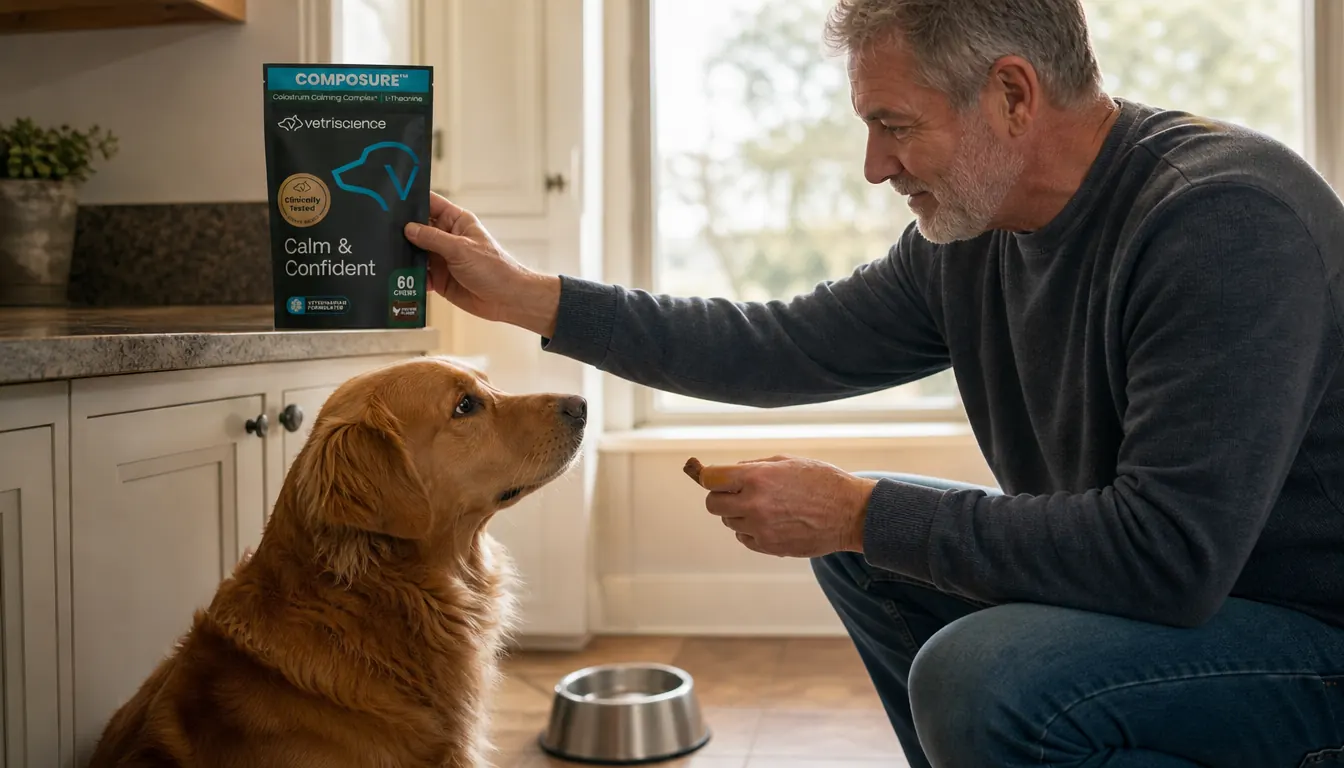
VETRISCIENCE Composure chews are chicken flavored, 60 to a container, with thiamine, a colostrum calming complex and L-theanine on the label. The company says the formula is clinically tested to work within 30 minutes and hold for up to 4 hours. Ask your vet about it first, especially if your dog is on medication.
Amazon Check Today's Price on Amazon →Why Storms Land Harder on Some Dogs
A storm is not one thing. It is a drop in air pressure, a change in the way sound carries, static in the air, and light coming through the window at the wrong angle. Dogs read all of it. Some read it and go back to sleep. Others read it and decide the house is no longer safe, and no amount of reassurance from you will rewrite that conclusion in the middle of a Tuesday night.
Age matters and so does hearing. A dog who is losing his hearing can be startled by a rumble he cannot place, which is part of why Biscuit got worse at 10 than he was at 6. Pain matters too. A dog with an aching hip does not want to be handled during a storm, and a dog who cannot hear the storm coming gets no chance to brace for it. None of that is a training failure. It is a dog doing the best he can with the information he has.
Step 1: Have the Vet Conversation on a Quiet Tuesday, Not During the Storm
VETRISCIENCE Composure chews list three active ingredients at set amounts: thiamine, which is vitamin B1, at 134 mg, a colostrum calming complex listed as C3 at 22 mg, and L-theanine, the Suntheanine brand, at 21 mg. The container holds 60 chicken-flavored chews and weighs 7.36 ounces. The company says the formula carries National Animal Supplement Council certification and was clinically tested to work within 30 minutes and last up to 4 hours.
I want you to call your vet first, and not because I think a chew is dangerous. I want you to call because a dog who pants and paces through a storm is sometimes a dog with a heart problem, a thyroid problem, or pain that the weather simply makes louder. Our vet found Biscuit's hip change during a routine visit I nearly cancelled. If your dog is on any medication, bring the container or a clear photo of the label to the appointment and ask about interactions.
While you have the vet on the phone, ask about the amount. This product is labeled for small dogs, and Biscuit at 28 pounds sits near the top of that range. The label gives the amount by weight, so use it, and ask whether your dog's weight puts him somewhere else on that chart.
Step 2: Give It 30 Minutes of Lead Time and Know How Long It Holds
Thirty minutes is the number VETRISCIENCE puts on the label, and it matches what I watched at the front desk for 19 years. A chew handed over when the dog is already climbing the walls is a chew handed over too late. So the routine is radar, not thunder. I check the weather app when I get up and again after lunch. If the line of storms is two hours out, I set the stove timer and give the chew at the 30 minute mark.
The other number is four hours. That is how long the company says one chew holds. A summer system can sit over Chattanooga for six hours of rain even when only 15 minutes of it is loud, and fireworks on the fourth of July never last four hours but the neighborhood does. So treat the chew as coverage for the worst window and have a plan for the rest of it. For us that means the fan, the hallway and the television.
And give the first one on an ordinary day. Not during a storm, not right before a vet visit, not the first time you leave him alone. Give it on a Tuesday when nothing is happening and watch for four hours. If it makes him sleepy in a way that worries you, or if his stomach turns over, you want to learn that on a Tuesday. Biscuit has a sensitive stomach and he did fine, but that is one dog out of one house.
Step 3: Build the Den He Chooses, Not the One You Would Choose
The first real storm after we adopted Biscuit, I did what I now know is the wrong thing. I hauled him into the bedroom, shut the door and held him. He fought me the whole time. A scared dog does not automatically want your lap, especially when your lap is next to a window with lightning going off behind it.
What works better is offering three or four places that are low, enclosed and away from glass, then letting him pick. Our hallway bathroom has no windows and a tile floor that stays cool. The closet under the stairs works for some dogs. The gap between the sofa and the wall works for others. Put a worn t-shirt of yours in each one, add a fan or a white noise machine, and get out of the way. If he chooses the bathroom floor, let him have the bathroom floor.
Two notes. Do not lock a dog into a crate he ignores the rest of the year, because a crate that only appears during storms becomes a bad place fast. And do not drag him out of his spot so you can comfort him. Comfort offered is a different thing from comfort forced, and dogs know it.
Step 4: Change What Your Own Body Is Doing
Dogs read us better than we read them. If you jump up every time the thunder cracks and start talking in the voice you use for sick puppies, you have just told your dog there is something to fear and that you fear it too. I am not saying be cold. I am saying be boring.
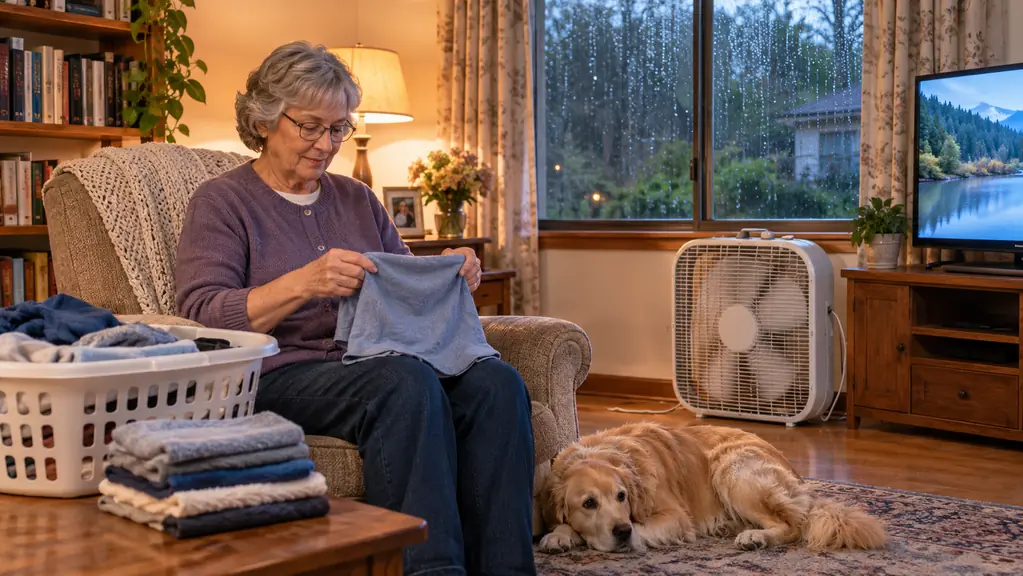
Dale's approach, which annoyed me for years and which I now admit works, is to keep folding laundry. Lights on, television at a normal volume, one hand on the dog if the dog wants a hand, no running commentary. The sound of the dryer does more in our house than anything I could say out loud. If your dog settles next to you while you do something ordinary, you have told him the storm is ordinary.
Step 5: Write It Down, Because You Will Not Remember It Right
I keep a small notebook in the kitchen drawer and it is the most useful thing I did. Three columns. Time the chew went in, time the first thunder hit, and a score from one to five at 30 minutes, one hour, two hours and four hours. One means asleep on the rug. Five means pacing, panting and clawing at the door. It takes 30 seconds and it turns a vague memory into something our vet can actually use.
You will be surprised what the notebook shows you. The storm you remember as terrible may have been 40 minutes long with a dog who slept through the last two hours. The storm you barely noticed may have been the one where he would not eat dinner. Memory on a stressful night is unreliable, and a supplement is an expensive thing to keep buying on a hunch.
After three or four storms, take the notebook to your vet. If the score stays at four or five, the chew is not carrying the load and you need a different plan, which might mean a different product, a behavior consult, or a prescription. If the score has dropped by two points from where you started, you have something that works, and now you know it instead of guessing.
Thirty minutes of lead time and a windowless hallway did more for Biscuit than two years of me saying it is okay, buddy, in my softest voice.
What Else Helps
A fan in the hallway is cheap and does two jobs. It masks the low rumble and it moves air, and a dog who is panting hard appreciates moving air. A white noise machine or a radio tuned between stations does the same work. I know people who swear by a pressure wrap, and I have seen them help the dogs who tolerate them, but plenty of dogs hate being squeezed and will fight it. Try it on a calm day first, exactly the way you would the chew.
For fireworks the plan is the same as storms with more lead time, because you know the date. Close the windows, run the fan, give the chew 30 minutes before the neighborhood starts, and skip the backyard party that year. For car rides and vet visits, the company's own direction is the same 30 minutes of cushion. For Biscuit that means he walks into the clinic on his own four feet instead of being carried, and at his age that is worth a lot.
Grooming is the one people forget. A dog who is already wound tight does not need a nail trim on the same afternoon as a thunderstorm forecast. Move the appointment. Nobody at the groomer's will mind, and your dog will not spend the rest of the day recovering from both things at once.
What I Would Skip
I would skip anything you found in a comment thread, including the human antihistamines, because the amount that is fine for one dog is not fine for another and the ones that make a dog drowsy do not make him less afraid. I would skip the advice to stand outside with him during a storm so he learns it is fine. That is not learning, that is flooding, and it tends to make the next storm worse.
I would also skip buying three calming products in the same week. If you change the chew, the wrap and the routine all at once, you have no idea which one helped. Start with the routine, because it costs nothing, then add the chew for a month, then decide with your notebook in hand.
When to Stop and Call the Vet
Call the vet if your dog injures himself during a storm, stops eating for more than a day around one, cannot settle for hours afterward, or if the panting does not stop when the weather does. Those are signs the fear has grown past what a chew and a fan can manage, and there are real options beyond that point, from a behavior consult to prescription medication your vet can discuss with you honestly. There is no prize for white-knuckling it, and your dog cannot tell you he is struggling with words.
One container covers a storm season, not one storm
Composure chews come 60 to a container, which is enough to plan ahead instead of scrambling the night the radar turns red. Give the first one on an ordinary afternoon, keep the notebook going, and let your own vet weigh in before it becomes a habit.
Amazon Check Today's Price on Amazon →